
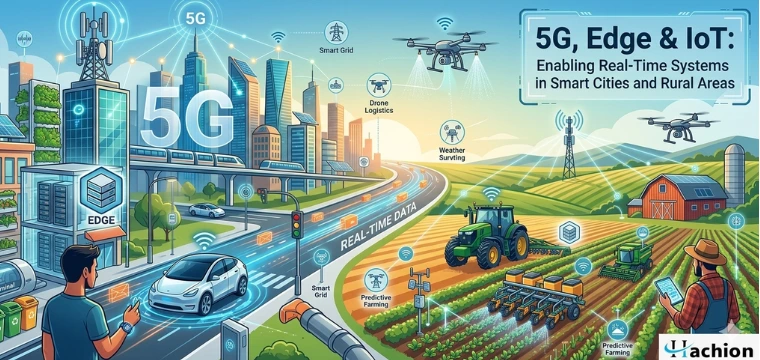
5G, Edge & IoT: Enabling Real-Time Systems in Smart Cities and Rural Areas
Introduction
In today’s hyperconnected world, three technologies—5G, Edge Computing, and the Internet of Things (IoT)—are working together to reshape how we live, work, and interact with our environment. From smart traffic lights that adjust to congestion, to remote farming systems monitoring soil health in rural areas, these innovations are making “real-time” intelligence a reality.
Let’s break down what these technologies are, how they connect, and where they’re transforming our world.
What is 5G?
5G stands for the fifth generation of mobile networks. It’s the successor to 4G LTE and brings major upgrades in speed, latency, and connectivity.
Key features of 5G:
- Ultra-fast speeds — up to 100 times faster than 4G.
- Low latency — delays reduced to as little as 1 millisecond.
- Massive connectivity — can connect up to 1 million devices per square kilometer.
Why it matters:
This isn’t just about faster smartphones. 5G enables technologies that depend on instant communication — like self-driving cars, robotic surgeries, and smart factories.
What is Edge Computing?
Edge computing means bringing computing power closer to where data is generated — “the edge” of the network — rather than relying entirely on distant cloud servers.
Example:
Suppose a smart traffic camera detects an accident. In that case, edge computing allows it to process that video on-site and alert authorities immediately, instead of sending the data to a faraway cloud server first.
Benefits:
- Reduced latency – faster decision-making.
- Improved reliability – works even with limited internet access.
- Enhanced privacy – sensitive data stays local.
Edge computing works best when combined with 5G because 5G provides the speed and connectivity edge devices need to share data efficiently.
What is the Internet of Things (IoT)?
IoT refers to the network of physical objects — sensors, machines, appliances — that connect to the internet to collect and exchange data.
Examples include:
- Smart home devices (lights, thermostats, security cameras).
- Industrial machines in factories.
- Health wearables like smartwatches.
- Smart city sensors that track air quality or traffic flow.
- IoT devices generate massive data, and that’s where edge computing and 5G come in — enabling this data to be processed and acted on in real time.
How 5G, Edge, and IoT Work Together
These three technologies form a powerful digital ecosystem:
Technology Role
- 5G provides ultra-fast, reliable connectivity.
- Edge Computing Processes data locally for faster decisions.
- IoT generates and collects data from devices.
Together, they enable real-time systems that were impossible just a few years ago.
Applications in Smart Cities
- Smart Traffic Management
- 5G-connected sensors adjust signal lights dynamically to reduce congestion.
- Edge computing processes video feeds instantly for traffic optimization.
- Public Safety & Surveillance
- AI cameras analyze real-time video for unusual activity.
- 5G ensures quick alerts to authorities.
- Energy Efficiency
- IoT-enabled grids balance electricity supply and demand.
- Edge analytics detect faults or wastage instantly.
- Smart Waste Management
- Sensors in bins alert when they’re full, optimizing collection routes.
Applications in Rural Areas
- Smart Agriculture
- IoT sensors monitor soil moisture, crop health, and weather.
- Edge computing allows local analysis, even with poor internet.
- 5G supports drone-based monitoring and precision farming.
- Remote Healthcare
- 5G enables telemedicine and remote diagnosis with minimal lag.
- Wearable IoT devices continuously track patients’ vitals.
- Rural Infrastructure Monitoring
- IoT sensors track water levels, bridges, and power grids in real time.
Technologies Powering 5G, Edge, and IoT
- AI & Machine Learning – to analyze IoT data and make predictions.
- Cloud & Edge Hybrid Systems – balance data processing between local and central servers.
- Network Slicing (5G feature) – creates virtual networks for specific use cases (like healthcare or manufacturing).
- Cybersecurity Frameworks – secure billions of connected devices.
Challenges
- While the potential is huge, some hurdles remain:
- Data privacy and security of IoT devices.
- Infrastructure costs in rural regions.
- Interoperability — connecting devices from different manufacturers.
The Future
- As 5G networks expand and edge computing becomes mainstream, expect:
- Smarter, more automated cities.
- Sustainable farming with real-time insights.
- Seamless healthcare access in remote areas.
- These technologies are not just futuristic — they’re already shaping our world today.
FAQs
Q1. What’s the difference between 4G and 5G?
A: 5G is faster, supports more devices, and has lower latency than 4G, enabling real-time applications like self-driving cars.
Q2. How does edge computing improve IoT?
A: Edge computing processes IoT data locally, reducing delays and improving reliability — especially where internet access is limited.
Q3. Can 5G and IoT work without edge computing?
A: Yes, but not as efficiently. Edge computing ensures data is processed faster and reduces cloud dependence.
Q4. Is 5G available in rural areas yet?
A: Coverage is expanding globally, but full rural rollout may take time. Some pilot programs are already connecting farms and small towns.
Q5. Are there privacy risks with IoT devices?
A: Yes — IoT devices collect sensitive data, so encryption, authentication, and security updates are essential.
Conclusion
The convergence of 5G, Edge Computing, and IoT is not just a technological evolution — it’s a revolution that’s reshaping how we live, work, and connect. From smarter cities that optimize traffic in real time to rural areas empowered by digital farming and remote healthcare, these innovations are paving the way for a more intelligent and inclusive world.
If you’re passionate about learning how these emerging technologies work and want to build real-world skills in AI, IoT, and next-generation connectivity, now is the perfect time to start.
Enroll in Hachion and take your first step toward mastering the technologies shaping the future.


