
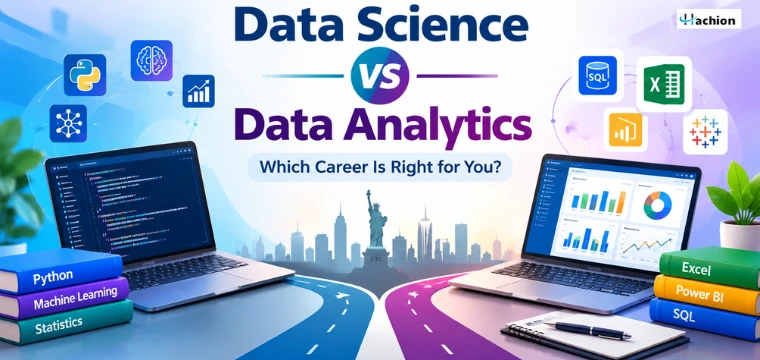
Data Science vs Data Analytics: Which Career Is Right?
Every business has data, but turning that data into meaningful decisions requires the right skills. Some professionals uncover insights from existing information, while others build models to predict what might happen next. This is where understanding Data Science vs Data Analytics becomes important, especially if you are planning to build a career in technology.
Although these fields share several tools and techniques, they differ in their goals, daily responsibilities, and technical requirements. Choosing between them can feel challenging when you are just starting out. If you are unsure which career to pursue, this guide will help you understand the differences between data science and data analytics, the skills you need to develop, and the path that best fits your interests.
What Is Data Analytics?
Data analytics involves analysing available data to uncover meaningful insights and help organisations make informed business decisions. Data analysts often work with structured datasets and commonly use tools such as SQL, Excel, Power BI, and Tableau.
A typical data analyst may investigate questions such as:
- Why did sales increase or decrease?
- Which products are performing well?
- What customer trends are visible in the data?
- Which marketing campaign generated better results?
- How is business performance changing?
The findings are often presented through dashboards, reports, charts, and presentations.
Important Data Analyst Skills
To start learning data analytics, focus on:
- SQL and database fundamentals
- Excel and data preparation
- Power BI or Tableau
- Basic statistics
- Data cleaning
- Data visualisation
- Business communication
Data analytics can be a practical starting point for learners who enjoy working with numbers, business problems, dashboards, and visualisations.
What Is Data Science?
Data science brings together programming, mathematics, statistics, data analysis, and machine learning to solve complex problems. Data scientists work with large datasets to uncover patterns, generate insights, and create models that can help organisations forecast trends and make data-driven decisions.
As an example, an organisation may analyse customer data to predict potential customer loss. A data scientist could analyse historical customer information and build a machine learning model to identify patterns associated with customers leaving.
Important Data Science Skills
Key data science skills include:
- Python programming
- SQL
- Statistics and probability
- Data cleaning and exploration
- Machine learning
- Data visualisation
- Model evaluation
- Problem-solving
Python is particularly important because it provides libraries and frameworks for data analysis, visualization, and machine learning.
Data Science vs Data Analytics: Key Differences
The data science vs data analytics comparison becomes easier when you look at the type of work involved.
Data analytics generally focuses on:
- Understanding past and current business performance
- Finding trends and patterns
- Creating dashboards and reports
- Answering specific business questions
- Communicating insights to stakeholders
Data science generally focuses on:
- Exploring complex datasets
- Applying statistical techniques
- Building predictive models
- Using machine learning
- Solving more advanced analytical problems
There is also an overlap between the two fields. For example, both data analysts and data scientists may use SQL, Python, statistics, and data visualisation depending on the organisation and role.
Data Analyst vs Data Scientist: Day-to-Day Work
A data analyst may spend the day collecting data, writing SQL queries, cleaning datasets, creating Power BI dashboards, analysing trends, and discussing findings with business teams.
A data scientist may spend the day preparing datasets, exploring patterns, writing Python code, testing statistical approaches, training machine learning models, and evaluating model performance.
The exact responsibilities vary between companies. Job titles are not standardised, so reading individual job descriptions is important when applying for positions.
Data Analytics Careers in the USA
There are data analytics careers in the USA across industries such as technology, finance, healthcare, retail, manufacturing, and marketing.
Common roles include:
- Data Analyst
- Business Intelligence Analyst
- Reporting Analyst
- Marketing Analyst
- Financial Data Analyst
These positions may involve SQL, Excel, Power BI, statistics, reporting, and data visualisation.
Data Science Roles in the USA
Data science roles in the United States can include:
- Data Scientist
- Applied Data Scientist
- Machine learning-focused roles
- Decision Scientist
Requirements vary by company. Some positions may emphasise statistical analysis, while others require stronger machine learning, programming, or experimentation skills.
Data Science vs Data Analytics: Which Path Should You Choose?
If you are unsure where to start, a few simple factors can help you determine which field aligns better with your interests, skills, and career goals.
Consider data analytics if you:
- Enjoy business problem-solving.
- Like dashboards and data visualisation.
- Want to work with SQL and Power BI.
- Prefer explaining insights through reports.
- Are interested in understanding business performance.
Consider data science if you:
- Enjoy programming and mathematics.
- Want to learn machine learning.
- Like predictive modelling.
- Enjoy experimenting with algorithms.
- Want to solve complex technical problems.
There is no need to choose one path permanently at the beginning of your journey. Starting with SQL, statistics, data visualisation, and basic Python can give you a foundation for exploring both areas.
How to Start Learning Data Analytics or Data Science
If you're pursuing a career in data analytics, build your foundation with Excel, SQL, statistics, and Power BI, then strengthen your knowledge through hands-on projects. Build dashboards using real-world datasets and practise explaining the insights you discover.
For data science, begin with Python, statistics, data analysis, and visualisation before progressing into machine learning. Hands-on projects allow you to see how these skills are used to solve practical, real-world challenges.
A portfolio can also demonstrate your ability to work with data and communicate your results.
Build Your Data Skills with Hachion Online Trainings
Choosing between data science and data analytics is only the beginning. Building practical skills and working on real-world projects can help you move toward your preferred career path.
Hachion Online Trainings provides training in data analytics, data science, Python, SQL, Power BI, and other technology areas. Live online learning, practical assignments, recordings, and expert guidance can help learners develop relevant technical skills.
If you are ready to strengthen your data skills, explore Hachion Online Trainings and take the next step toward your career goals.
Frequently Asked Questions (FAQs)
1. Is Data Science or Data Analytics the Better Career Choice?
A: Both offer different career paths. Data analytics emphasises SQL, data visualisation, reporting, and business insights, while data science typically involves programming, statistics, predictive modelling, and machine learning. Your skills, interests, and long-term career goals can help determine which path suits you.
2. Can I Learn Data Analytics Without Coding?
A: Yes. You can begin data analytics with Excel, Power BI, data visualisation, and basic statistics. However, SQL is an important skill for querying databases, while learning Python can help you handle automation, data processing, and more advanced analytics tasks.
3. Can a Data Analyst Become a Data Scientist?
A: Yes. Data analysts can transition into data science by developing skills in Python, advanced statistics, machine learning, predictive modelling, and data preparation. Building practical projects can also help demonstrate your ability to apply these skills to data science problems.
4. Is Python Required for Data Analytics?
A: Python is not required for every data analyst role. Many analytics tasks rely on SQL, Excel, Power BI, statistics, and visualisation. However, Python can expand your capabilities for data cleaning, automation, advanced analysis, and handling larger or more complex datasets.
5. What Should I Learn First: SQL or Python?
A: If your goal is to start in data analytics, SQL is a practical first choice because it helps you retrieve and analyse data from databases. Python can be added afterward for automation, advanced analytics, data science, and machine learning.


