
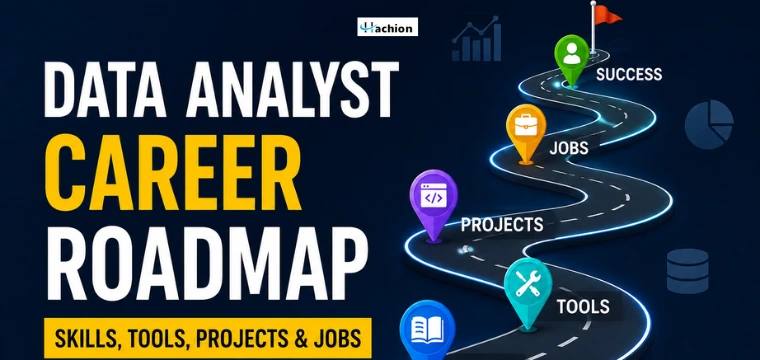
Data Analyst Career Roadmap: Skills, Tools, Projects & Jobs
If you enjoy working with data, solving business problems, and turning numbers into useful insights, a career in data analytics can be a strong choice. However, knowing what to learn first can be confusing. A clear Data Analyst Career Roadmap helps you understand the essential skills, tools, projects, and job preparation needed to enter the field.
A Data Analyst Career Roadmap takes you from basic data concepts to practical projects and career preparation. Whether you are a student, career changer, or working professional, following a structured path can make your learning more focused and effective.
What Does a Data Analyst Do?
A data analyst collects, cleans, analyzes, and interprets data to help businesses make informed decisions.
Common responsibilities include:
- Collecting and cleaning data
- Analyzing trends and patterns
- Writing SQL queries
- Creating reports and dashboards
- Building data visualizations
- Identifying business problems
- Presenting insights to stakeholders
Data Analyst Career Roadmap: Step-by-Step Path
1. Learn Data Analytics Fundamentals
Start with basic concepts such as:
- Types of data
- Data cleaning
- Descriptive statistics
- Mean, median, and mode
- Percentages and ratios
- Correlation
- Data interpretation
Strong fundamentals make it easier to work with advanced tools later.
2. Master Excel
Excel remains an important skill for data-related roles.
Learn:
- Formulas and functions
- IF statements
- XLOOKUP/VLOOKUP
- Pivot Tables
- Charts
- Conditional formatting
- Data cleaning
- Basic dashboards
3. Learn SQL
SQL is one of the most valuable technical skills for data analysts.
Focus on:
- SELECT statements
- WHERE conditions
- GROUP BY
- ORDER BY
- JOIN operations
- Subqueries
- CASE statements
- Aggregate functions
- Common Table Expressions
- Window functions
Practice using real-world datasets rather than just memorizing syntax.
4. Learn Python for Data Analysis
Python can help analysts automate tasks and work with larger datasets.
Focus on:
- Python fundamentals
- Variables and data types
- Lists and dictionaries
- Functions
- Loops
- File handling
- NumPy
- Pandas
- Matplotlib
- Data cleaning
- Exploratory data analysis
5. Learn Data Visualization
Knowing how to communicate insights is just as important as finding them.
Popular Data Analyst Tools include:
- Power BI
- Tableau
- Excel
- Python visualization libraries
Learn how to create clear dashboards, choose appropriate charts, and present data effectively.
6. Develop Essential Data Analyst Skills
Technical knowledge alone is not enough. Important Data Analyst Skills include:
- Analytical thinking
- Problem-solving
- Communication
- Business understanding
- Attention to detail
- Critical thinking
- Data storytelling
- Presentation skills
- Time management
A strong analyst should explain not only what happened, but also why it happened and what should happen next.
Data Analyst Tools You Should Learn
Choosing the right tools is an important part of your learning journey. Your toolset may vary depending on the job, but several technologies are commonly useful.
- Excel: Useful for spreadsheets, calculations, reporting, and quick analysis.
- SQL: Essential for querying and analyzing information stored in databases.
- Python: Useful for data cleaning, analysis, automation, and more advanced analytical workflows.
- Power BI: Useful for interactive dashboards, reports, business intelligence, and data visualization.
- Tableau: Another popular visualization platform used to create interactive dashboards and communicate insights.
- Git: Learning basic Git can help you manage your projects and demonstrate your work through a professional portfolio.
Rather than trying to master every tool, focus on developing strong fundamentals and becoming comfortable with the tools most relevant to your target roles.
Build Real-World Data Analyst Projects
Practical projects help demonstrate your skills to employers.
Consider building projects such as:
- Sales Analysis: Analyze revenue, products, regions, and customer segments.
- Customer Churn Analysis: Identify patterns associated with customer retention and churn.
- Marketing Analysis: Measure campaign performance, conversions, and customer acquisition.
- Employee Attrition Analysis: Explore workforce data to identify factors related to employee turnover.
For each project, explain the business problem, data preparation, analysis, findings, visualizations, and recommendations.
Build a Data Analyst Portfolio
A strong portfolio can help demonstrate your practical abilities.
Include:
- 3 to 5 quality projects
- SQL queries
- Power BI or Tableau dashboards
- Python notebooks
- Data cleaning examples
- Business recommendations
Focus on quality and explain how your analysis solves a real business problem.
Prepare for Data Analyst Jobs
Once you have developed your skills and portfolio, prepare for Data Analyst Jobs by creating a targeted resume and practicing interviews.
Highlight:
- Technical skills
- Projects
- Tools
- Certifications
- Relevant experience
- Portfolio or GitHub links
Practice questions involving SQL, Excel, Python, statistics, visualization, business scenarios, and behavioral topics.
How to Start a Data Analyst Career With No Experience
You do not necessarily need professional experience to start building credibility.
Gain practical experience through:
- Personal projects
- Open datasets
- Internships
- Freelance work
- Case studies
- Volunteer projects
Your goal should be to demonstrate that you can take a business problem, analyze data, and communicate meaningful recommendations.
Why Choose Hachion Online Training?
Learning independently can be challenging when you are unsure what to study or how to apply your knowledge.
Hachion provides online IT training designed to help learners develop practical technology skills through structured learning.
If you want to build your data analytics skills, explore Hachion's relevant training programs and choose a learning path aligned with your career goals.
Ready to start your journey?
Explore Hachion online training and take the next step toward becoming a job-ready data professional.
Frequently Asked Questions(FAQ’s)
1. How much time does it take to become a data analyst?
A: It depends on your background and learning schedule. Focus first on Excel, SQL, statistics, visualization, and Python, then build practical projects.
2. Is data analysis a good career?
A: Yes. Data analysis can be a strong career option for people who enjoy technology, problem-solving, business, and working with data.
3. What skills are required to become a data analyst?
A: Key skills include Excel, SQL, statistics, data visualization, analytical thinking, communication, and problem-solving. Python is also valuable.
4. Is SQL necessary for data analysts?
A: SQL is highly valuable because many analysts use it to retrieve and analyze information stored in databases.
5. Is a Computer Science Background Necessary for a Career in Data Analytics?
A: Yes. People from business, finance, mathematics, engineering, and other backgrounds can transition into data analytics by developing the right skills and practical experience.
6. Which tools should a beginner learn first?
A: A practical starting combination is Excel, SQL, Power BI or Tableau, and Python.
7. How Many Projects Should You Include in a Data Analyst Portfolio?
A: Start with 3 to 5 strong projects that demonstrate different skills and solve realistic business problems.
Final Thoughts
A successful data analytics career requires more than learning tools. Build strong fundamentals, develop your Data Analyst Skills, practice with real-world projects, create a portfolio, and prepare for interviews.
Start learning today with Hachion online IT training and take the next step toward becoming a job-ready data professional.


