
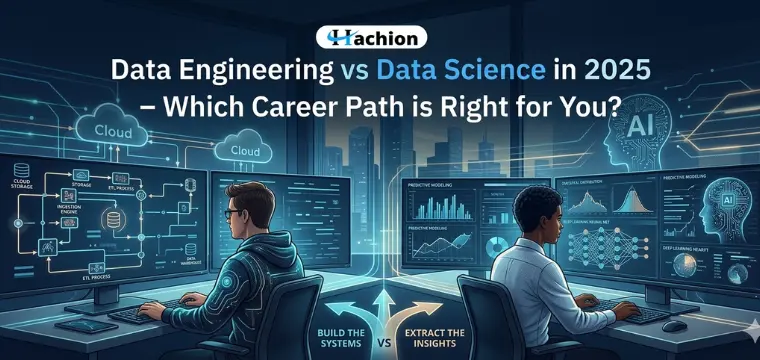
Data Engineering vs Data Science in 2025 – Which Career Path is Right for You?
As we step deeper into 2025, data has become the heartbeat of every business. From launching breakthrough products to delivering personalized customer experiences, organizations lean heavily on data and analytics to stay competitive. The rapid growth of big data, AI, and cloud computing has fueled massive demand for two roles that sit at the core of this revolution: Data Engineers and Data Scientists.
On the surface, the two roles might appear alike, but the work they do and the expertise they require are very different.
Data Engineers create the framework that makes data usable, while Data Scientists extract meaning and insights from it. If you’re exploring a career in data and wondering which path suits you best, this guide will help you decide.
What is Data Engineering?
Imagine a bustling city. Before cars can move smoothly, someone has to build and maintain the roads, bridges, and traffic systems. That’s exactly what Data Engineers do for the world of data—they create the infrastructure that ensures information flows seamlessly and remains reliable.
What Data Engineers Do:
- Build and manage data pipelines that collect and organize raw information
- Integrate data from multiple sources such as apps, databases, and IoT devices
- Guarantee accuracy, consistency, and security of data.
- Utilize large-scale data technologies such as Hadoop, Spark, and Kafka to manage and process information.
- Optimize data storage using cloud solutions (AWS, Azure, GCP)
- Partner with Data Scientists to prepare and refine datasets so they can be effectively analyzed.
Skills Every Data Engineer Needs in 2025
- Strong coding in Python, Java, Scala, SQL
- Deep understanding of ETL processes
- Hands-on experience with cloud-based data warehouses like Snowflake, BigQuery, or Redshift
- Knowledge of real-time data processing and workflow automation
What is Data Science?
If Data Engineers build the roads, Data Scientists are the drivers. They use those pathways to navigate through massive datasets, applying advanced techniques to identify patterns, make predictions, and guide strategic business choices.
What Data Scientists Do:
- Analyze structured and unstructured datasets
- Develop and train machine learning models
- Present data through impactful visualizations that convey clear and compelling insights.
- Conduct predictive and prescriptive analytics
- Empower leaders to make smarter, evidence-backed decisions
- Skills Every Data Scientist Needs in 2025:
- Proficiency in Python and R
Expertise with ML & AI frameworks (TensorFlow, PyTorch, Scikit-learn)
Solid foundation in statistics and mathematics
Proficiency in visualization platforms such as Tableau, Power BI, or Matplotlib is essential.
Awareness of cutting-edge fields like Generative AI, NLP, and large language models (LLMs)
Data Engineering vs Data Science: A 2025 Comparison

Key Career Trends in 2025
AI Everywhere
- Data Engineers are expected to build AI-powered automation into data pipelines.
- Data Scientists rely on Generative AI to accelerate model development.
- Cloud-First World
- Companies are embracing multi-cloud strategies for flexibility and scalability.
- Both Engineers and Scientists must master cloud technologies.
- Real-Time Decisions
- With IoT and 5G, real-time insights are no longer optional.
- Engineers work with Kafka and Spark Streaming, while Scientists deploy real-time predictive models.
Insights > Dashboards
Businesses want outcomes, not just pretty graphs. While Data Scientists influence business strategy through insights, Data Engineers guarantee that data systems are scalable and reliable.
Which Career Should You Pick?
Your choice depends largely on your natural strengths and professional ambitions.
- Go for Data Engineering if…You enjoy programming and solving technical challenges
You want to build the “plumbing” that makes analytics possible. You prefer operating in the background, making sure that systems function smoothly and without disruption.
Choose Data Science if… You’re fascinated by statistics, AI, and machine learning
You want to uncover insights that directly impact strategy. You see yourself shaping innovations across industries
Job Roles Waiting in 2025
Data Engineering Roles:
- Big Data Engineer
- Cloud Data Engineer
- ETL Developer
- Data Architect
Data Science Roles:
- Machine Learning Engineer
- AI Researcher
- Business Data Scientist
- NLP/Generative AI Specialist
Both tracks promise high-paying, future-proof careers. Industry forecasts suggest that careers in data and analytics will expand by more than 30% during the period from 2025 to 2030.
Why Data Science May Have the Edge
Both careers are critical, but Data Science is gaining unmatched versatility. As industries adopt automation, predictive analytics, and AI-driven decision-making, the ability to translate raw data into actionable business strategies has become priceless.
Whether it’s healthcare predicting patient outcomes, finance fighting fraud, or e-commerce personalizing shopping, Data Scientists are at the heart of innovation.
Shape Your Future with Hachion
If you’re ready to enter the world of data and want to be future-ready, Hachion’s Data Science Course can give you the competitive edge.
Here’s why learners choose Hachion:
- Real-world projects in AI, ML, and Big Data
- Mentorship from experienced professionals
- Globally recognized certification
- Flexible, beginner-friendly online classes
Don’t wait. Enroll in Hachion’s Data Science Program today and unlock opportunities to thrive in the most in-demand field of 2025.
Final Takeaway
Data Engineers and Data Scientists are like two sides of the same coin—one builds the foundation, the other drives the journey. If you’re a system builder at heart, Data Engineering is your calling. If you enjoy uncovering patterns and solving complex problems, a career in Data Science could be the right fit for you. Whichever path you choose, one thing is certain: 2025 is the year to invest in a career in Data & Analytics.
Your voice matters!
What are your thoughts on the Data Engineering vs Data Science career path in 2025?
Do you connect more with the role of a Data Engineer (designing systems and pipelines) or a Data Scientist (deriving insights and driving decisions)?
👉 Drop your views, experiences, and feedback in the comments — your insights might guide someone else in choosing their career direction!


