
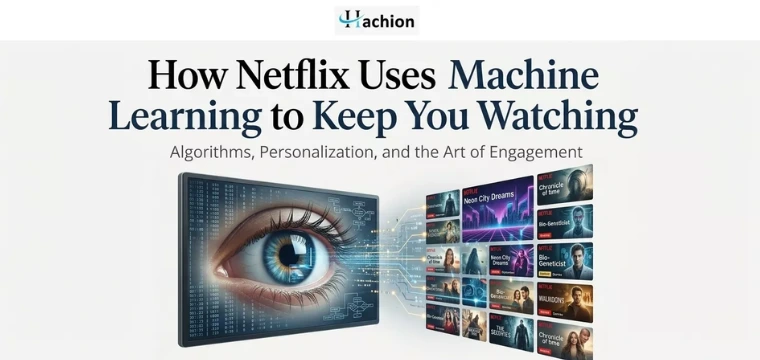
How Netflix Uses Machine Learning: Behind the Technology that Keeps You Watching
Introduction
Have you ever thought about how Netflix always seems to suggest exactly the kind of content you’d enjoy next?
You finish a thriller, and suddenly, three more edge-of-the-seat thrillers pop up on your home screen. Or you start watching a romantic drama, and the platform instantly recommends similar tearjerkers. This isn’t magic—it’s Machine Learning (ML) at work.
Streaming platforms like Netflix, Amazon Prime, Hulu, and Disney+ rely heavily on ML to predict viewer preferences, personalize experiences, optimize streaming quality, and even decide what shows to produce next.
Interestingly, Netflix attributes its machine learning–powered recommendation engine to saving the company more than $1 billion every year, as it helps keep users entertained and prevents them from unsubscribing.
In this blog, let’s break down:
What Machine Learning means for streaming platforms
- How Netflix uses ML to recommend shows, create thumbnails, and improve streaming?
- The role of Big Data in making it all work.
- Why does this matter for viewers and professionals?
How can you upskill in Machine Learning with Hachion to build a rewarding career in AI?
What is Machine Learning in Simple Terms?
At its core, Machine Learning is a type of Artificial Intelligence (AI) where systems “learn” from data and improve over time without needing explicit programming.
Think of it this way:
- Traditional programming: The developer writes explicit instructions, and the computer executes them one step at a time.
- Machine Learning: You give data → computer finds patterns → computer makes predictions.
- For Netflix, this means analyzing billions of hours of viewing history, likes/dislikes, watch duration, and even when people pause or quit a show.
Using this data, ML models figure out:
- What do you like to watch?
- What are you likely to watch next?
- How to keep you hooked for longer?
How Netflix Uses Machine Learning
1. Personalized Recommendations
This is Netflix’s biggest strength. Nearly four out of every five shows or movies watched on Netflix are driven by personalized recommendations.
- Collaborative Filtering: This method works by analyzing your viewing preferences and comparing them with the choices of other users who share similar interests.
- If Person A and Person B both loved Money Heist, and Person A also loved Breaking Bad, chances are Netflix will recommend Breaking Bad to Person B.
- Content-Based Filtering: Netflix also analyzes the attributes of the shows you’ve watched—genre, cast, director, language, and storyline—to suggest similar titles.
👉 Example: If you watched Stranger Things, you’ll likely see other sci-fi shows with teen protagonists and supernatural themes.
2. Smart Thumbnails & Artwork
Have you noticed how the same show has different posters or thumbnails depending on who is watching? That’s ML in action.
Netflix experiments with multiple images for the same show and uses ML to decide which thumbnail is most likely to grab your attention.
- If you like romantic movies, you’ll see a Friends thumbnail featuring Ross & Rachel.
- If you’re more into comedy, you might see Joey doing something funny.
- This personalization boosts click-through rates dramatically.
3. Predicting What Will Keep You Hooked
- Netflix doesn’t just stop at recommendations—it studies how long you watch a show and when you drop off.
- If viewers are quitting a series after Episode 2, Netflix analyzes why. Was the pacing too slow? Was the plot unappealing?
- Using ML, they can even predict whether a new show will succeed before it’s released by comparing it with historical data.
- This helps Netflix decide where to invest its billion-dollar content budget.
4. Streaming Quality Optimization
Ever noticed how Netflix adjusts video quality smoothly when your internet slows down? That’s ML working in the background.
- ML algorithms analyze:
- Your network speed
- e Device capability
- Bandwidth usage in your area and then automatically optimize video delivery so you don’t see buffering screens.
5. Original Content Decisions
Machine Learning also plays a role in content production. Netflix doesn’t just randomly create shows—it studies what genres are trending, which actors audiences love, and what markets are growing.
That’s why we see hits like Squid Game (Korean drama trend) or Money Heist (global love for thrillers). ML signals guide these billion-dollar decisions.
The Role of Big Data in Netflix’s ML System
Behind Netflix’s ML magic lies Big Data. With over 260 million subscribers worldwide (2025 estimate), Netflix generates petabytes of data every single day.
This includes:
- Search queries
- Viewing history
- Device used (mobile, TV, laptop)
- Ratings, likes, and shares
- Pause, rewind, and forward actions
- All this data is processed in real time by ML algorithms to keep the platform highly personalized.
Why Does This Matter for You?
For Viewers
You get:
- Personalized recommendations that save browsing time
- Better viewing experience (no buffering, sharp thumbnails)
- Access to content you’re more likely to enjoy
For Professionals
At present, the worldwide streaming industry is valued at over $500 billion and is expanding at an impressive pace. With ML at the heart of these platforms, there’s a massive demand for AI and Data Science professionals who can build similar systems.
Jobs in this field include:
- Machine Learning Engineer
- Data Scientist
- Recommendation System Specialist
- AI Product Manager
- Professionals in this field typically earn between $90,000 and $150,000+ per year, with pay varying based on expertise and experience.
How You Can Learn Machine Learning & Build a Career Like Netflix Engineers
If you’re excited about how ML powers Netflix and want to build similar technologies, this is the right time to upskill.
Institutions like Hachion offer industry-focused Machine Learning and AI courses that cover:
- Python for ML
- Recommendation systems (like Netflix’s algorithm)
- Deep learning & neural network
- Big Data integration
Real-time projects to make you job-ready

💡 By enrolling in Hachion’s Machine Learning program, you don’t just learn theory—you practice on live industry projects, preparing you for high-demand roles in AI, data, and cloud industries.
Conclusion
Netflix is more than just a streaming service it’s a technology powerhouse powered by Machine Learning. From personalized recommendations to predictive content investments, ML ensures that you stay glued to the platform. And here’s the exciting part: you can learn to build such systems yourself. With the right skills in ML, you could work on projects that shape the future of entertainment, finance, healthcare, and beyond.
If you’re serious about entering this booming industry, enroll in Hachion’s Machine Learning course today and start your journey towards becoming an AI professional.
The world is watching—and with ML skills, you could be the one building what they watch next!


