
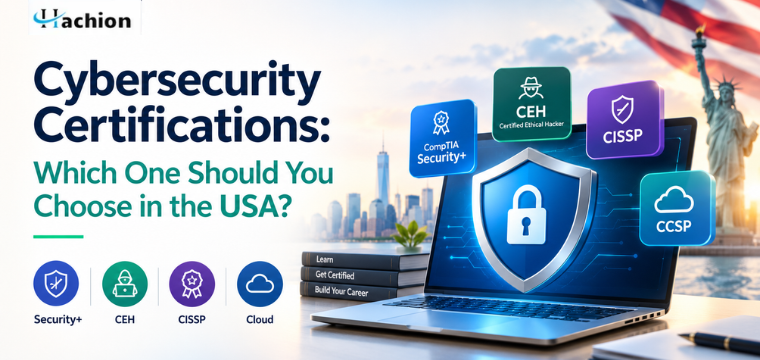
Cybersecurity Certifications: Which One Should You Choose in the USA?
Choosing among cybersecurity certifications can feel confusing because each credential focuses on different skills, experience levels, and career goals. If you are planning a cybersecurity career in the USA, the right certification should match your current knowledge, the role you want, and the practical skills you need to demonstrate.
Cybersecurity certifications are valuable because they can provide structured learning and help employers understand what areas of security you have studied. The U.S. Bureau of Labour Statistics reports that information security analyst employment is projected to grow 21% from 2025 to 2035, with about 14,100 openings expected each year. Employers may also prefer professional certification for information security analyst roles.
https://api.hachion.co/prod/upload_all_images/Cyber_Security_Cyber_Security_cybersecurity_CTA.webp
Why Cybersecurity Certifications Matter for Your Career
Cybersecurity is not a single job category. Organisations hire professionals for security operations, vulnerability management, ethical hacking, cloud security, governance, risk, compliance, incident response, and security architecture. That means one certification cannot cover every career path.
For beginners, a foundation-focused certification can help establish core concepts. Professionals with hands-on experience may choose a specialized credential or a certification designed for broader security leadership.
Cybersecurity Certifications for Different Career Stages
1. Security+ for Foundational Security Knowledge
CompTIA Security+ is commonly considered a starting point for people building foundational cybersecurity knowledge. It is relevant to learners who want to understand threats, vulnerabilities, security architecture, identity, risk, and security operations.
This path can make sense if you are moving into cybersecurity from IT support, networking, system administration, or another technology role.
2. CEH for Ethical Hacking and Offensive Security
If your goal is ethical hacking, penetration testing, or offensive security, Certified Ethical Hacker (CEH) is another certification to research. EC-Council provides two eligibility routes: official training or an experience-based application for candidates with at least two years of information security experience.
3. CISSP for Experienced Security Professionals
CISSP is designed for experienced cybersecurity practitioners, managers, and professionals working across multiple security domains. ISC2 states that candidates need at least five years of cumulative full-time experience in two or more CISSP domains, with limited experience-waiver options.
The certification covers areas including security and risk management, asset security, security architecture, network security, identity and access management, security assessment, security operations, and software development security.
Because of its experience requirement and broad scope, CISSP is generally something to consider after building substantial professional experience rather than treating it as a first cybersecurity credential.
4. Cloud Security Certifications for Cloud-Focused Roles
Cloud adoption has changed how organizations protect applications, identities, data, and infrastructure. If you want to work specifically in cloud security, consider a certification aligned with cloud architecture, data security, platform security, application security, operations, and compliance.
For example, ISC2's CCSP covers six cloud security domains. Candidates normally need five years of IT experience, including three years in cybersecurity and one year in a relevant CCSP domain, although certain education or credential pathways can modify the requirement.
How to Choose the Right Cybersecurity Certification
Start with the job role, not the certification name. Search current USA job descriptions for roles such as security analyst, SOC analyst, penetration tester, cloud security engineer, security consultant, or security manager. Identify the recurring skills and certifications employers mention.
Next, evaluate your experience. A beginner may need foundational networking and security knowledge first. An IT professional may already have enough technical background to move into a security-focused certification. An experienced security professional may benefit more from a certification covering governance, architecture, risk, or leadership.
Another step is to compare certification objectives with the responsibilities listed in job postings. Look for repeated requirements such as SIEM monitoring, vulnerability management, identity controls, incident response, cloud platforms, compliance, or penetration testing. This approach keeps your study plan and helps you choose training that supports the type of work you want to perform. It also prevents spending time on credentials that do not match your role.
Cybersecurity Certification USA: Skills to Build Alongside Certification
A strong cybersecurity certification USA strategy should include skills beyond exam preparation. Build networking fundamentals, Linux administration, Windows security, identity and access management, vulnerability assessment, incident response, cloud platforms, and basic scripting.
The BLS identifies computers and information technology, adaptability, and writing and reading as important skills for information security analysts. This reinforces the value of combining technical knowledge with communication and adaptability.
Is One Cybersecurity Certification Enough?
Usually, career development is better viewed as a progression than a single exam. You might begin with foundational security knowledge, develop hands-on experience, specialise in ethical hacking or cloud security, and later pursue a broader professional certification.
Your path can also change. Someone starting in a SOC may later move into cloud security, incident response, governance, or security architecture. The best certification for your next step may therefore be different from the best certification for your first step.
Keep your certification plan connected to real projects. Build a home lab, practice analyzing logs, document security scenarios, work with cloud security controls, or complete guided exercises. These activities can help you turn theoretical knowledge into practical capability.
Start Building Your Cybersecurity Skills with Hachion Online Trainings
If you want structured guidance while preparing for a cybersecurity career, Hachion online trainings can help you build job-oriented knowledge through instructor-led learning and practical training options. Explore the cybersecurity programme that matches your current level and career direction, strengthen your technical foundation, and prepare for your next professional step.
Enroll in Hachion online trainings to learn cybersecurity concepts, practice relevant skills, and build a focused learning path. Choose training based on your experience, target role, and certification goals rather than simply selecting the most popular credential.
Frequently Asked Questions (FAQs)
1. Which cybersecurity certification is best for beginners?
A: A foundation-focused certification such as Security+ can be a starting point for learners who are developing core cybersecurity knowledge. Your choice should depend on your existing networking, IT, and security fundamentals.
2. Is CEH good for an ethical hacking career?
A: CEH can provide structured knowledge of ethical hacking concepts and techniques. For a stronger practical profile, combine certification preparation with labs, networking, Linux, scripting, and security testing exercises.
3. Can I get a CISSP without five years of experience?
A: You can take the CISSP exam without meeting the full experience requirement and become an ISC2 Associate if you pass. You then have a defined period to complete the required experience.
4. Which certification is useful for cloud security?
A: A cloud-focused credential such as CCSP can be relevant for professionals targeting cloud security roles. Review the certification domains and experience requirements before choosing it.
5. Do cybersecurity certifications guarantee a job in the USA?
A: No certification guarantees employment. Certifications can demonstrate structured knowledge, but employers may also evaluate practical skills, experience, communication, education, projects, and role-specific capabilities.
Conclusion
Choosing cybersecurity certifications becomes easier when you start with your career destination. Beginners can build fundamentals, aspiring ethical hackers can explore offensive security, cloud professionals can develop cloud security expertise, and experienced practitioners can consider broader credentials such as CISSP.
The goal is not to collect certificates. The goal is to build skills that match real cybersecurity responsibilities. Combine certification study with practical training, projects, and continuous learning to create a stronger professional foundation.


