
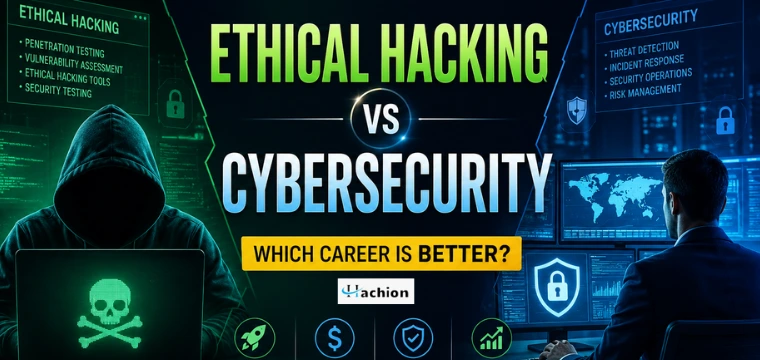
Ethical Hacking vs Cybersecurity: Which Career Is Better?
The demand for cybersecurity professionals is growing rapidly as businesses continue to face cyberattacks, ransomware threats, cloud security challenges, and data breaches. When students and IT professionals explore security-related careers, one of the biggest questions they ask is: Ethical Hacking vs Cybersecurity: Which Career Is Better?
Both career paths offer excellent salaries, global job opportunities, and long-term growth. However, many beginners feel confused about the difference between ethical hacking and cybersecurity. Some people assume both careers are the same, while others believe ethical hacking is more technical than cybersecurity.
Understanding Ethical Hacking vs Cybersecurity is important before choosing a career path because both fields require different skills, certifications, responsibilities, and career goals. Whether you are a student, an international student, a fresher, or a working professional planning to switch careers, knowing the differences can help you make a better decision.
What Is Ethical Hacking?
Ethical hacking is the process of identifying security vulnerabilities in computer systems, applications, and networks with permission from organizations. Ethical hackers are also known as white-hat hackers because they use hacking techniques legally to improve security.
The main goal of ethical hacking is to find weaknesses before cybercriminals exploit them. Ethical hackers perform penetration testing, vulnerability assessments, network scanning, and security testing to protect organizations from attacks.
Ethical hackers usually work with:
- Penetration testing tools
- Network security systems
- Web application security
- Password testing
- Vulnerability management
- Security auditing
Popular job roles in ethical hacking include:
- Ethical Hacker
- Penetration Tester
- Security Analyst
- Vulnerability Assessor
- Red Team Engineer
What Is Cybersecurity?
Cybersecurity is a broader field focused on protecting systems, networks, cloud environments, applications, and data from cyber threats. Cybersecurity professionals create security strategies, monitor systems, prevent attacks, and respond to incidents.
Unlike ethical hacking, cybersecurity covers multiple domains, such as:
- Network security
- Cloud security
- Application security
- Data protection
- Incident response
- Risk management
- Security operations
- Compliance and governance
Cybersecurity professionals work to prevent attacks before they happen and minimize damage if a breach occurs.
Common cybersecurity job roles include:
- Cybersecurity Analyst
- SOC Analyst
- Security Engineer
- Cloud Security Engineer
- Cybersecurity Consultant
- Incident Response Analyst
Ethical Hacking vs Cybersecurity: Major Differences
Although ethical hacking is a part of cybersecurity, both careers have different responsibilities and focus areas.
Ethical hacking focuses mainly on offensive security. Professionals attempt to break into systems ethically to identify vulnerabilities.
Cybersecurity focuses on defensive security. Professionals protect systems, monitor threats, and build secure environments.
Here are some key differences:
Ethical Hacking:
- Offensive security approach
- Finds vulnerabilities through testing
- Uses hacking tools and penetration testing methods
- More focused on attacking systems ethically
Cybersecurity:
- Defensive security approach
- Prevents attacks and secures systems
- Focuses on monitoring, protection, and risk management
- Covers broader IT security operations
Which Career Has Better Job Opportunities?
The job market for both ethical hacking and cybersecurity is growing worldwide. Companies across healthcare, finance, cloud computing, e-commerce, and government sectors need skilled security professionals.
Cybersecurity usually offers more job openings because it includes multiple specialized domains. Organizations need professionals for cloud security, SOC operations, compliance, incident response, and risk management.
Ethical hacking is highly specialized and valuable, especially for organizations conducting security audits and penetration testing.
If you enjoy:
- Problem-solving
- Hacking tools
- Security testing
- Finding vulnerabilities
Then, ethical hacking may be a good fit.
If you enjoy:
- Security monitoring
- Protecting systems
- Risk analysis
- Cloud security
- Security operations
Then cybersecurity may be a better career option.
Salary Comparison
Both careers offer strong salary potential depending on skills, certifications, experience, and location.
Ethical hackers with strong penetration testing skills are highly valued because companies need experts who can simulate real-world attacks.
Cybersecurity professionals also receive competitive salaries due to the growing number of cyber threats worldwide.
Professionals with certifications and hands-on experience usually receive better salary packages.
Best Certifications for Ethical Hacking
Some popular ethical hacking certifications include:
- CEH (Certified Ethical Hacker)
- CompTIA PenTest+
- OSCP (Offensive Security Certified Professional)
- eJPT Certification
These certifications help students gain practical penetration testing knowledge and improve job opportunities.
Best Certifications for Cybersecurity
Popular cybersecurity certifications include:
- CompTIA Security+
- CISSP
- CISM
- CCSP
- Certified SOC Analyst
Cybersecurity certifications are useful for building knowledge in security operations, cloud security, governance, and risk management.
Skills Required for Ethical Hacking
To become successful in ethical hacking, students should learn:
- Networking fundamentals
- Linux commands
- Penetration testing
- Python scripting
- Web application security
- Vulnerability analysis
- Ethical hacking tools
Hands-on practice is extremely important in ethical hacking because employers value practical experience.
Skills Required for Cybersecurity
Cybersecurity professionals should focus on:
- Security monitoring
- Incident response
- SIEM tools
- Cloud security
- Risk management
- Security frameworks
- Threat analysis
Cybersecurity also requires analytical thinking, communication skills, and knowledge of security compliance.
Ethical Hacking vs Cybersecurity: Which Career Is Better for Students?
There is no single answer because the best career depends on your interests and strengths.
Choose ethical hacking if:
- You enjoy technical challenges
- You like penetration testing
- You enjoy ethical hacking tools
- You are interested in offensive security
Choose cybersecurity if:
- You prefer defensive security
- You enjoy protecting systems
- You want broader career opportunities
- You are interested in cloud and enterprise security
Many professionals actually start in cybersecurity and later specialize in ethical hacking.
Why Security Careers Are Growing Rapidly
The rise of AI-powered attacks, cloud computing, remote work, and digital transformation has increased the need for cybersecurity experts globally.
Organizations are investing heavily in:
- Cloud security
- Threat detection
- Security automation
- AI-based security systems
- Compliance and data protection
This creates excellent opportunities for students and IT professionals entering the security industry.
Build Your IT Career with Hachion Online Training
If you want to start a successful career in ethical hacking or cybersecurity, proper training and practical learning are important.
Hachion offers industry-focused online IT training programs designed for students, graduates, international students, and working professionals. The training includes practical projects, real-world cybersecurity concepts, mentorship support, and career-focused learning paths.
Students can learn:
- Ethical hacking fundamentals
- Cybersecurity concepts
- Cloud technologies
- AI and automation tools
- Real-world IT skills
Hachion helps learners build technical expertise and prepare for modern IT careers through flexible online learning.
Conclusion
The debate around Ethical Hacking vs Cybersecurity continues because both careers offer excellent growth opportunities. Ethical hacking is ideal for people who enjoy offensive security and penetration testing, while cybersecurity is better for professionals interested in broader security operations and system protection.
Both career paths are highly valuable in today’s digital world. The best approach is to choose a field that aligns with your interests, learning style, and long-term career goals.
With the right certifications, practical projects, and continuous learning, students can build a strong and future-ready career in the cybersecurity industry.
https://api.hachion.co/prod/upload_all_images/Cyber_Security_Cyber_Security_cybersecurity_CTA.webp
Frequently Asked Questions (FAQs)
1. Is ethical hacking part of cybersecurity?
A: Yes. Ethical hacking is one domain within the broader field of cybersecurity.
2. Which career is better: ethical hacking or cybersecurity?
A: Both careers are excellent. Ethical hacking focuses on offensive security, while cybersecurity focuses on protecting systems and managing security operations.
3. Does ethical hacking require coding?
A: Basic programming knowledge is useful in ethical hacking, especially Python and scripting concepts.
4. Is cybersecurity a good career for beginners?
A: Yes. Cybersecurity offers multiple beginner-friendly career paths, such as SOC Analyst and Security Analyst roles.
5. Which certification is best for ethical hacking?
A: CEH and OSCP are among the most recognized ethical hacking certifications.
6. Can international students build careers in cybersecurity?
A: Yes. Cybersecurity skills are in high demand globally, making it a strong career option for international students.
7. Is cybersecurity stressful?
A: Cybersecurity roles can sometimes be challenging because professionals handle security threats and incidents, but the field also offers strong career growth and salaries.
8. Which field has higher salary potential?
A: Both ethical hacking and cybersecurity offer high-paying opportunities depending on skills, certifications, and experience.


