
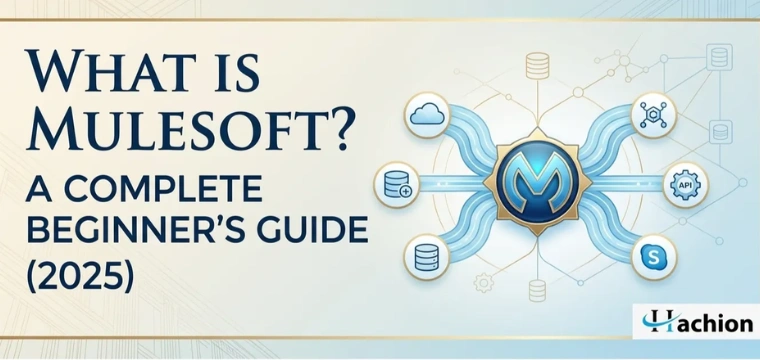
In today’s digital-first world, businesses rely on hundreds of applications, platforms, and data sources. But here's the challenge—how do you make them work together seamlessly? This is where MuleSoft steps in as a game-changer.
MuleSoft is more than just an integration tool. It’s a powerful platform that enables organizations to connect everything—from apps and databases to services and devices regardless of where they are hosted. Whether you're a developer, IT professional, or someone curious about how modern systems communicate, this blog will walk you through the essentials of MuleSoft in a clear, beginner-friendly manner.
What is MuleSoft?
MuleSoft essentially serves as a platform for integrating data and managing APIs. It provides tools to connect applications, data, and devices across cloud-based and on-premise environments. Think of it as a digital translator that helps different software systems "speak" to each other efficiently.
The name “MuleSoft” comes from the idea of a "mule" carrying a heavy integration load—something that traditionally required a lot of manual work and custom coding.
Founded in 2006 and acquired by Salesforce in 2018, MuleSoft’s flagship product is the Anypoint Platform, which helps organizations build application networks using APIs.
Why Do Businesses Use MuleSoft?
Imagine an e-commerce business using separate systems for its online store, customer service, inventory, and payment processing. When systems aren’t integrated, they operate independently, causing redundancy, slow processes, and mistakes.
With MuleSoft, the business can create APIs (Application Programming Interfaces) to connect these systems. This allows data to flow securely and efficiently in real time. For example:
- Customer support teams can instantly access order history.
- Inventory updates automatically after each sale.
- Payment confirmations are synchronized across platforms.
- In short, MuleSoft helps businesses become faster, more connected, and customer-focused.
Key Components of MuleSoft
Here are the main tools that make MuleSoft so effective:
- Anypoint Studio
A powerful, Eclipse-based IDE with a drag-and-drop interface for building APIs and integrations. It simplifies complex tasks and accelerates development.
- Anypoint Platform
The central hub for designing, deploying, managing, and monitoring APIs and integrations.
- API Designer
"With RAML (RESTful API Modeling Language), MuleSoft enables users to design APIs through a browser-based tool."
- API Manager
A control center for securing APIs, managing access, and tracking usage analytics.
- Anypoint Exchange
A marketplace of pre-built APIs, templates, connectors, and other reusable assets to speed up development.
Real-World Use Cases of MuleSoft
MuleSoft is widely used across industries like healthcare, finance, retail, logistics, and more. Let’s look at some examples:
- Healthcare
Hospitals use MuleSoft to integrate electronic health records (EHRs) across departments, allowing doctors to access patient data instantly.
- Retail
Retailers integrate POS (Point of Sale) systems with inventory and CRM platforms for real-time stock and customer management.
- Finance
Banks automate loan approvals, credit checks, and secure data transfers by connecting core systems with third-party services.
- Logistics
Logistics companies use MuleSoft to track shipments by connecting GPS data, order systems, and delivery apps.
Reasons Behind MuleSoft’s High Demand in 2025
In a world increasingly driven by automation, cloud adoption, and connected experiences, integration is no longer optional—it’s essential. Here’s why MuleSoft is in high demand:
- Cloud-native and scalable
- Supports hybrid and multi-cloud environments
- Robust security and governance features
- Reusable APIs save time and money
- Seamless support for microservices and event-driven architecture
Businesses that achieve quicker integration gain a competitive advantage—and MuleSoft makes that possible.
Who Can Learn MuleSoft?
MuleSoft is beginner-friendly and doesn’t require extensive experience to get started.
- Java Developers – Since MuleSoft is built on Java, existing Java skills are helpful.
- Integration Engineers – Professionals managing data flow between systems.
- IT Admins and Analysts – Those looking to upskill in modern tools.
- Freshers & Career Switchers – Anyone with basic programming logic can learn MuleSoft and pursue a career in integration.
Skills You Need to Learn MuleSoft
While MuleSoft simplifies integration, having these skills can speed up your learning:
- Basic Java or object-oriented programming
- Familiarity with XML and JSON (data formats)
- Understanding REST/SOAP APIs
- Knowledge of web services
- Cloud computing basics and DevOps (bonus)
MuleSoft Certification Path
Getting certified in MuleSoft increases your credibility and job prospects. Here are the top certifications:
- MuleSoft Certified Developer – Level 1 (Mule 4)
Ideal for beginners. Covers API design, integration flows, and basic debugging.
- MuleSoft Certified Integration Architect
Focuses on high-level enterprise integration planning and implementation.
- MuleSoft Certified Platform Architect
Designed for those who build scalable and secure API ecosystems.
Each certification comes with global recognition, making you stand out in the job market.
Career Opportunities & Salaries
MuleSoft professionals are highly sought after in sectors such as consulting, healthcare, banking, telecom, and e-commerce.
Job Roles Include:
- MuleSoft Developer
- Integration Engineer
- API Consultant
- Solution Architect
- DevOps Integration Specialist
Average Salaries (2025):

These numbers continue to grow as more organizations adopt API-led connectivity.
How to Start Your MuleSoft Journey
If you’re ready to step into the world of integration, here’s a simple roadmap:
- Understand API concepts – Know how systems communicate through APIs.
- Set up Anypoint Studio and try creating simple integrations to get hands-on practice.
- Explore MuleSoft documentation – It’s official, detailed, and beginner-friendly.
- Join a formal training program—structured learning helps you progress more quickly.
- Work on practice projects – Try small integration tasks on dummy data.
- Earn your first certification – Start with Developer Level 1 (Mule 4).
Apply for internships or jobs – Real-world projects will grow your skillset.
Learn MuleSoft with Hachion
At Hachion, we offer industry-relevant MuleSoft training designed to help you go from beginner to certified expert—no fluff, just real-world skills. With hands-on projects, expert mentors, and certification guidance, our MuleSoft course sets you up for success in today’s integration-driven market.
📚 Ready to Start?
👉 Explore Hachion’s MuleSoft Course and take the first step toward a future-proof career!
Final Thoughts
MuleSoft is more than just a technical tool—it’s a career catalyst in today’s hyper-connected digital economy. As APIs continue to shape business innovation, professionals who can manage and build those APIs are in high demand. Whether you're just starting your tech journey or looking to upskill, MuleSoft offers flexibility, growth, and rewarding opportunities.


