
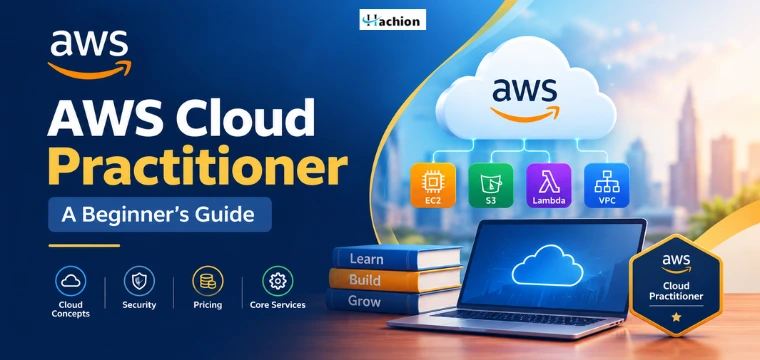
AWS Cloud Practitioner: A Beginner’s Guide
Cloud computing supports many digital services, from online shopping and video streaming to business applications and data storage. Terms such as virtual servers, cloud regions, and usage-based pricing can feel unfamiliar at first. Learning the basics helps you understand how companies use cloud technology.
The AWS Cloud Practitioner certification introduces the core ideas behind Amazon Web Services (AWS). It covers cloud concepts, common services, security, pricing, and the business value of cloud computing. You can begin without being an experienced engineer, but steady study and practical examples will help you connect the concepts to real situations.
What Does the Certification Cover?
The AWS Cloud Practitioner certification is an entry-level credential designed to assess foundational knowledge of AWS and cloud computing. It introduces the purpose of cloud services and explains how organisations approach security, operations, and costs.
This credential is not proof that someone can independently design complex systems or manage live infrastructure. Think of it as a starting point: it builds a shared vocabulary and helps you understand conversations about cloud solutions. Practical projects and further learning are still important for developing job-ready skills.
Why Learn Cloud Fundamentals?
AWS cloud fundamentals can help you understand technology decisions that affect businesses. You will explore how cloud services differ from maintaining physical infrastructure in a data centre and why organisations consider flexibility, reliability, security, performance, and spending when choosing a solution.
For learners exploring opportunities in the United States, basic cloud knowledge may be relevant to IT support, project coordination, operations, technical customer service, and sales roles. Certification should be treated as evidence of learning rather than a promise of employment.
Key Topics to Understand
Cloud Computing Concepts
Start by learning what Cloud computing means and why organisations use it. Understand scalability, elasticity, high availability, fault tolerance, and global infrastructure. Scalability means increasing or reducing capacity to meet changing needs. Elasticity describes how resources can adjust as demand changes. High availability aims to keep a service accessible, while fault tolerance helps a system continue working when a component fails.
Core AWS Services
You do not need to memorise every service in the AWS catalogue. Begin with commonly used services and understand what each one does. Amazon EC2 provides virtual computing capacity. Amazon S3 provides cloud storage for documents, images, and other digital content. AWS Lambda runs code in response to events without requiring you to manage servers directly. Amazon VPC lets you create logically isolated networking environments.
Understanding the purpose of a service is more useful than recalling its name without context.
Security and Shared Responsibility
Security is a core part of cloud learning. Under the AWS shared responsibility model, AWS manages security of the cloud, while customers are responsible for security in the cloud. The exact division depends on the service being used. AWS protects the underlying infrastructure, while customers must configure access and protect their own data appropriately.
Study identity and access management, least-privilege permissions, multifactor authentication, encryption, and monitoring. In practice, avoid sharing credentials, grant only necessary permissions, and check that sensitive files are not publicly accessible. Security requires careful choices and ongoing attention.
Pricing, Billing, and Support
Cloud costs depend on factors such as service selection, usage, data transfer, and configuration. Learn how pay-as-you-go pricing works and how certain commitments may reduce costs for eligible usage. The AWS Pricing Calculator can help estimate expenses before you build a solution, while billing tools can help track spending and investigate unexpected charges.
Never assume that every service or level of usage is free.
Reliability and Cloud Architecture
AWS operates global infrastructure organised into Regions and Availability Zones. A Region is a separate geographic area, while Availability Zones are distinct locations within a Region. Placing resources thoughtfully can support resilience, but the right design depends on an application's requirements.
How to Prepare for the Exam
A simple study routine can make preparation more manageable. Start with the official AWS exam guide, use it to organise your topics, and set aside regular time to review what you learn.
- Review the exam guide: Check the current exam scope and requirements before planning your study schedule.
- Learn essential services: Study computing, storage, databases, and networking at a foundational level.
- Understand security and pricing: Review access management, the shared responsibility model, billing, and cost tools.
- Practise sample questions: Read the explanations for both correct and incorrect answers, then revisit weaker topics.
- Try guided exercises: Use suitable demonstrations to connect theory with realistic cloud tasks.
- Revise consistently: Keep brief notes and return to difficult concepts throughout your preparation.
Keep a short glossary of unfamiliar terms, note how services relate to one another, and explain each idea in your own words. This habit can reveal gaps early and make revision sessions more focused weekly.
Beginner Mistakes to Avoid
Some learners focus only on passing the exam and miss the concepts behind the questions. You can make your study more effective by avoiding a few common habits.
- Memorising without context: Learn what each service does and when it might be appropriate.
- Neglecting security: Understand access controls, data protection, and shared responsibility.
- Ignoring costs: Monitor usage and remove resources after practice sessions.
- Relying only on question banks: Use practice questions to find gaps, then study the underlying topic.
- Skipping practical examples: Try small, guided activities to see how cloud concepts work.
- Studying without a plan: Set realistic weekly goals and track topics that need more revision.
Learn with Hachion Online Trainings
A structured course may help you organise your learning, particularly if you are balancing work, study, or family responsibilities. Hachion Online Trainings offers technology training options that learners can explore as part of their development plan. Before enrolling, review the syllabus, teaching format, instructor background, practical activities, schedule, and support available for questions.
Explore Hachion’s online training programs that match your learning goals. Make sure you understand the curriculum and any fees or terms before completing enrollment. A suitable course can provide structure, but your progress will also depend on regular revision, practice, and curiosity.
Final Thought
Cloud knowledge becomes more valuable when you can explain how services solve practical problems. Learn the fundamentals first, practise with realistic examples, and use reliable study resources to guide your preparation. You can then decide whether to explore architecture, development, data, security, or cloud operations in greater depth.
Frequently Asked Questions (FAQ’s)
1. What is the AWS Cloud Practitioner certification used for?
A: It introduces cloud computing concepts, AWS services, security, and pricing. The credential can help beginners demonstrate foundational knowledge before pursuing more specialised training or practical experience.
2. Is this certification suitable for beginners?
A: Yes. It is designed as an entry-level introduction, so previous cloud engineering experience is not required. Learners should still allow time to study the concepts and practise sample questions.
3. How should I prepare for the exam?
A: Read the official exam guide, study the core cloud topics, review common AWS services, and practise questions with explanations. Guided exercises can help connect concepts to real use cases.
4. Will certification guarantee a cloud job in the United States?
A: No certification can guarantee employment. Employers may also look for hands-on ability, communication, problem-solving, relevant experience, and knowledge that matches the role. Review job descriptions to identify the skills you need to develop.
5. How can Hachion help me learn AWS?
A: Hachion provides technology training options to explore. Review its available course details, curriculum, practical activities, and learning format to decide whether a program matches your goals. Confirm current details directly with Hachion before enrolling.


