
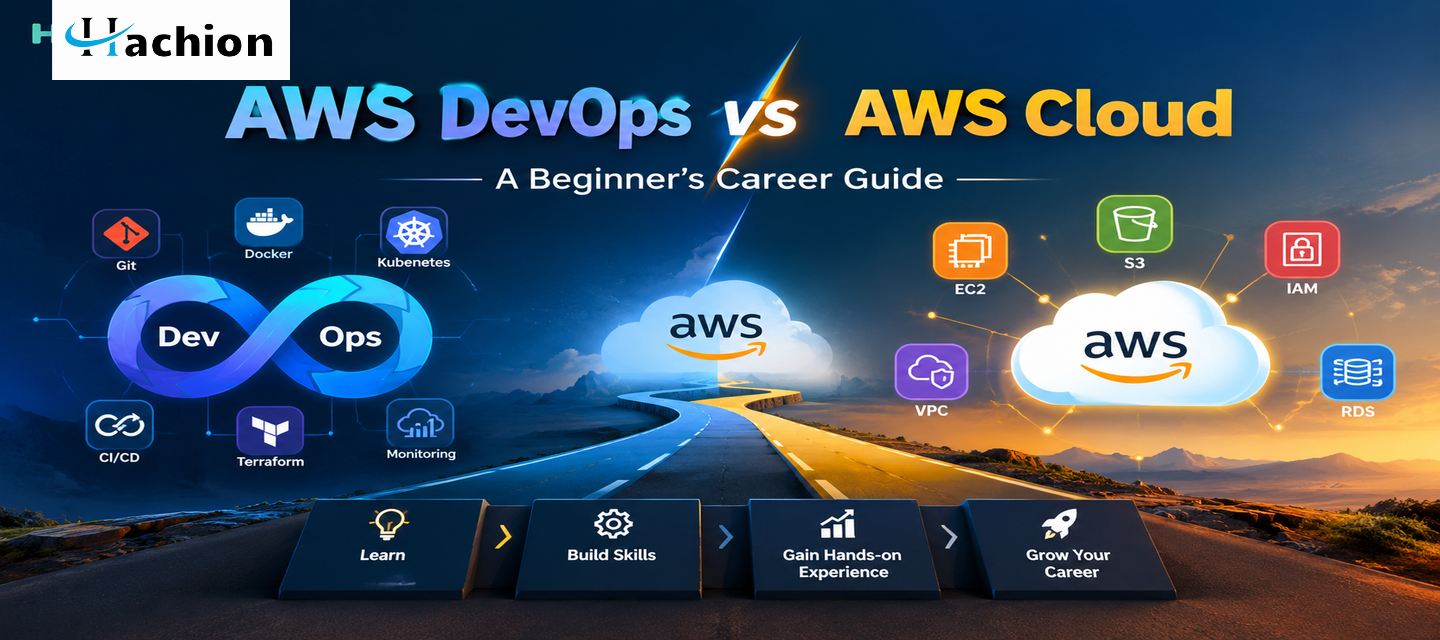
AWS DevOps vs AWS Cloud: A Beginner’s Career Guide
Imagine you are exploring a career in technology and come across two exciting areas: Cloud computing and DevOps. Both help businesses run applications smoothly, but the work involved in each field is different. You might wonder which one to learn first, what skills employers expect, and which path matches your interests. Exploring AWS DevOps vs AWS Cloud can help you answer these questions and make a more informed decision about your learning journey.
Think about an online shopping website that serves thousands of customers every day. It needs reliable servers, secure data storage, and properly configured networks to keep running. At the same time, developers must release updates, fix bugs, and improve the application without disrupting customers.
AWS Cloud focuses on the infrastructure that keeps applications running, while DevOps emphasizes automating software development, testing, and deployment. Understanding how these two areas work together can help you choose where to begin and which skills to develop next.
AWS DevOps vs AWS Cloud: Key Differences Explained
AWS Cloud includes services for computing, storage, networking, databases, and identity management. Cloud-focused professionals learn how these services work together to run secure, reliable applications.
AWS DevOps combines cloud knowledge with practices for building, testing, releasing, and operating software. Common areas include Git, scripting, continuous integration and continuous delivery (CI/CD), infrastructure automation, containers, and monitoring.
Imagine a retailer launching an online store. A cloud engineer may configure servers, storage, networks, and access permissions. A DevOps engineer may create a pipeline that tests code and deploys approved updates. Both support the store, but their daily priorities differ.
Key Skills Covered in AWS Cloud Training
AWS cloud training introduces the building blocks of cloud infrastructure. It can suit beginners who want to understand how online services operate.
Core topics include:
- Cloud fundamentals: Learn scalability, availability, and pay-as-you-go resources.
- Amazon EC2: Understand virtual servers and basic instance management.
- Amazon S3: Explore storage for files, backups, and application assets.
- AWS IAM: Learn about identities, roles, policies, and permissions.
- Amazon VPC: Understand networks, subnets, routes, and security groups.
- Monitoring and cost awareness: Review resource activity and avoid unnecessary spending.
A business moving its website to AWS needs computing resources, storage, networking, and controlled access. Cloud fundamentals explain how these pieces connect.
These skills may support cloud support, cloud operations, or junior cloud engineering roles. Requirements vary, so compare your skills with current job descriptions in your preferred US location.
Key Skills Covered in AWS DevOps Training
AWS DevOps training focuses on repeatable workflows that reduce manual steps in software delivery. It may suit learners who enjoy problem-solving, scripting, and improving processes.
Learning areas include:
- Git: Track code changes and collaborate.
- CI/CD pipelines: Automate building, testing, and deployment.
- Linux and scripting: Use command-line tools and basic Bash or Python.
- Docker: Package applications and dependencies into containers.
- Infrastructure as Code: Define infrastructure with Terraform or AWS CloudFormation.
- Monitoring and logs: Investigate errors and application performance.
- Kubernetes: Explore container orchestration when relevant to your goals.
For example, a team releasing website updates several times a week may use a CI/CD pipeline to run tests and package approved changes consistently. Teams still need reviews, security checks, and rollback plans; automation does not replace sound judgment.
DevOps roles often combine multiple skills. Linux, networking, version control, scripting, security basics, and troubleshooting can all matter.
Which Path Should Beginners Choose?
Start with your current knowledge, not the most impressive job title. If you are new to cloud technology, begin by understanding how servers, data storage, network connections, and access controls function before moving on to deployment automation.
A sequence is:
- Learn cloud basics. Explore core AWS services and how a simple application uses them.
- Practise Linux and Git. Learn common commands and track project changes.
- Build scripting confidence. Try simple Bash or Python tasks.
- Create a CI/CD workflow. Follow a project that tests and deploys a basic application.
- Explore containers and infrastructure automation. Practise Docker and Terraform or CloudFormation; add Kubernetes when useful.
- Document a project. Explain its purpose, tools, security choices, and troubleshooting steps.
The sequence is flexible. Developers may move into CI/CD earlier, while IT support professionals may already know networking. Prioritize skills repeated in target job descriptions.
Career Opportunities in the USA
People considering AWS cloud training or DevOps skills in the United States should compare responsibilities, not just titles. Cloud-related roles include cloud support associate, cloud operations specialist, and junior cloud engineer. DevOps-related roles may include build and release engineer, junior DevOps engineer, or cloud automation engineer. Some site reliability engineering positions require substantial production experience.
No course or certification guarantees employment. Requirements vary by employer, industry, location, and seniority. Read several job descriptions, identify recurring skills, and use them to guide your learning.
For your portfolio, deploy a small AWS application, set access controls, automate deployment, and configure monitoring. Control costs, remove unused resources, protect credentials, and explain your design choices.
Certifications demonstrate study, but practical experience and clear communication matter too.
Build Your Skills with Hachion Online Trainings
Ready to strengthen your cloud computing and DevOps knowledge? Hachion Online Trainings offers technical learning options for individuals who want to develop practical skills and understand modern IT technologies.
Explore Hachion Online Trainings to discover suitable courses, review the curriculum, and identify opportunities for hands-on practice.
Take the next step toward your learning goals! Explore Hachion’s training programs, choose the course that matches your interests, and start building your cloud and DevOps skills today.
Final Thoughts
AWS Cloud helps you understand the foundation on which applications run. DevOps adds practices that automate how applications are built, released, and maintained. For many beginners, cloud fundamentals followed by Linux, Git, scripting, CI/CD, and infrastructure automation is a practical route. Start small, practise consistently, and build a project you can confidently discuss. Keep notes on what worked, what failed, and how you solved issues during regular project practice.
Frequently Asked Questions (FAQ’s)
1. Is AWS Cloud easier than AWS DevOps?
A: Beginners should first learn cloud basics, including servers, storage, networking, and access management. DevOps builds on these concepts with scripting, version control, deployment automation, and hands-on practice.
2. Should I learn AWS before DevOps?
A: If you are starting your cloud journey, begin by exploring the essential services offered by AWS. Understanding servers, networking, permissions, and monitoring can help you build and troubleshoot automated pipelines later.
3. Can I learn AWS DevOps without coding experience?
A: Yes. Begin with command-line basics, Git, and simple scripts, then practise CI/CD and deployment projects. Basic scripting becomes increasingly useful as your skills develop.
4. Is AWS DevOps a good career choice in the USA?
A: It may suit people interested in infrastructure, automation, software delivery, and troubleshooting. Opportunities depend on employer needs, practical ability, experience, and location. Review US job descriptions before choosing skills to prioritize.
5. How can Hachion Online Trainings help me learn AWS DevOps?
A: Hachion Online Trainings is one option to investigate for structured learning. Review the curriculum, projects, trainer support, and lab practice before enrolling. Combine training with independent projects and regular practice.


