
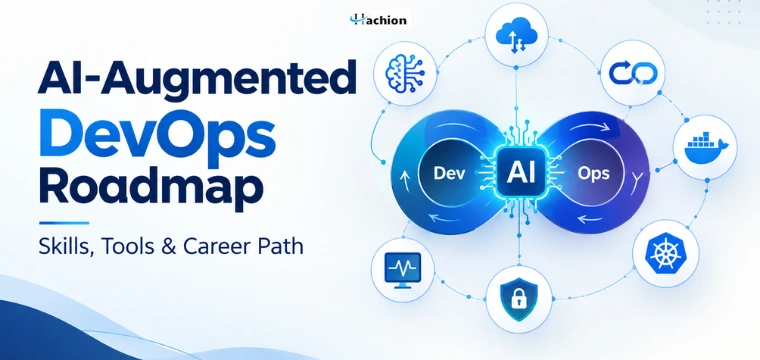
AI-Augmented DevOps Roadmap: Skills, Tools and Career Path
An AI-augmented DevOps roadmap helps professionals understand how traditional DevOps practices are evolving with artificial intelligence. Instead of replacing core DevOps knowledge, AI is being added to software development, testing, deployment, monitoring, security, and incident management.
An AI-Augmented DevOps Roadmap starts with strong DevOps fundamentals and gradually introduces AI-assisted development, automation, observability, AIOps, security, and responsible AI usage. The focus should be on understanding how AI can improve DevOps workflows, rather than trying to master every AI tool available. It is to understand where AI can reduce repetitive work, improve decisions, and support safer software delivery.
Why AI-Augmented DevOps Matters
DevOps focuses on collaboration, automation, continuous delivery, infrastructure management, and reliable operations. AI adds another layer by helping teams analyse technical information and automate tasks that previously required manual effort.
AI assistants can explain code, generate test cases, summarise logs, suggest fixes, review pull requests, and help investigate incidents. Modern agentic workflows can also allow AI systems to research a repository, plan changes, modify code, run tests, and prepare a pull request for human review.
AI-Augmented DevOps Roadmap: Step-by-Step Learning Path
1. Build Strong DevOps Fundamentals
Start with the foundation before adding AI. Learn Linux, networking, Git, version control, scripting, software development life cycles, and basic cloud concepts.
Understand how applications move from development to production. Learn continuous integration and continuous delivery, environment management, configuration, release strategies, and rollback practices.
A strong foundation makes AI tools more useful because you can recognise incorrect suggestions instead of accepting generated output blindly.
2. Learn Cloud Platforms
Choose one major cloud platform and develop practical experience. AWS and Azure are valuable options for learning cloud-based DevOps workflows.
Study compute, storage, networking, identity and access management, monitoring, containers, and managed services. Focus on building and deploying applications in a realistic environment.
3. Master Containers and Kubernetes
Learn Docker fundamentals, container images, registries, networking, volumes, and security. Then move to Kubernetes concepts such as pods, deployments, services, configuration, health checks, scaling, and rolling updates.
4. Learn Infrastructure as Code
Infrastructure as Code allows teams to define infrastructure through reusable configuration instead of creating resources manually.
Terraform is an important technology to learn, along with providers, variables, modules, state, plans, and version-controlled infrastructure. Practice reviewing infrastructure changes before applying them.
AI can help explain Terraform configurations, identify potential issues, suggest improvements, and generate drafts. Infrastructure changes should still be reviewed and tested before production use.
5. Develop CI/CD Automation Skills
Learn how pipelines build, test, scan, package, and deploy applications. GitHub Actions, GitLab CI/CD, Jenkins, and Azure Pipelines are useful technologies to understand.
Then explore AI-assisted pipeline development. AI can help create workflow files, explain failed jobs, summarise test results, and suggest improvements.
6. Add AI-Assisted Software Development
This is where the roadmap becomes distinctly AI-augmented. Learn how AI coding assistants can support developers throughout the software lifecycle.
Tools such as GitHub Copilot can suggest code, explain repositories, assist with testing, review changes, and support agentic development workflows.
Learn effective prompting, repository context, code review, testing, and AI limitations. Never treat generated code as automatically correct. Security, performance, licensing, and maintainability still require human judgement.
7. Learn Observability and AIOps
Modern DevOps requires visibility into application and infrastructure behaviour. Learn logs, metrics, traces, dashboards, alerts, service-level indicators, and incident management.
After learning observability fundamentals, explore AIOps concepts. AI can help identify patterns across operational data, reduce alert noise, summarise incidents, correlate signals, and support root-cause investigation.
8. Add DevSecOps and AI Security
Security should be part of the DevOps workflow, not an activity performed only at the end.
Learn dependency scanning, secret management, vulnerability assessment, identity management, container security, and secure CI/CD practices.
As AI becomes part of development and operations, also understand risks such as insecure generated code, exposed credentials, excessive permissions, prompt injection, and unreviewed automated changes.
9. Build Practical Projects
Projects are essential for demonstrating real skills. Begin with a basic application and gradually build an end-to-end DevOps workflow around it.
Build an application, containerise it with Docker, create a CI/CD pipeline, provision infrastructure with Terraform, deploy it to Kubernetes, and add monitoring.
Then introduce AI into selected steps. Use AI to review pipeline configurations, summarise logs, generate test cases, explain infrastructure code, or assist with incident investigation.
Document what AI did, what you reviewed manually, and what limitations you discovered.
Tools to Learn
A practical toolkit can include Git and GitHub, Docker, Kubernetes, Terraform, GitHub Actions, Jenkins or GitLab CI/CD, AWS or Azure, monitoring platforms, security tools, and AI coding assistants.
Do not try to learn everything simultaneously. Choose one cloud platform, one CI/CD platform, one Infrastructure as Code tool, and one AI assistant first. Build confidence through projects before expanding your toolkit.
Skills Needed for an AI-Augmented DevOps Career
The most useful skill set combines technical fundamentals with AI awareness. Key areas include Linux, Git, scripting, cloud computing, containers, Kubernetes, CI/CD, Infrastructure as Code, observability, cybersecurity, automation, AI-assisted development, prompt engineering, troubleshooting, and communication.
Equally important are judgement and problem-solving. DevOps engineers increasingly need to decide when automation is appropriate, when human approval is necessary, and how to validate AI-generated recommendations.
Is AI-Augmented DevOps a Good Career Path?
AI-Augmented DevOps can be a valuable direction for professionals who enjoy cloud infrastructure, automation, software delivery, and emerging AI technologies. The strongest approach is to build conventional DevOps expertise first and then apply AI where it provides measurable value.
This approach can make your knowledge useful across different tools, cloud platforms, and engineering environments.
Learn AI-Augmented DevOps With Hachion Online Trainings
If you want structured guidance instead of learning everything independently, Hachion Online Trainings offers technology-focused training around practical career skills. Learners can explore DevOps, cloud technologies, automation, AI, and related enterprise technologies through guided training.
A structured course can help you move from fundamentals to practical workflows while giving you a clearer learning path.
Build your foundation, practise with real projects, and gradually add AI to your DevOps workflow carefully. That combination can help you prepare for changing software delivery requirements.
Frequently Asked Questions (FAQ’s)
1. What is AI-Augmented DevOps?
A: AI-Augmented DevOps combines traditional DevOps practices with artificial intelligence to assist with coding, testing, automation, monitoring, security, deployment, and incident management.
2. Will AI replace DevOps engineers?
A: AI can automate or assist with repetitive DevOps tasks, but engineers are still needed for architecture, validation, security, troubleshooting, governance, and production decisions. AI changes workflows rather than eliminating technical judgement.
3. What should I learn first for AI-Augmented DevOps?
A: Start with Linux, Git, networking, scripting, cloud fundamentals, CI/CD, containers, and Infrastructure as Code. After building these foundations, learn AI-assisted development, AIOps, and AI security.
4. Which tools are important for AI-Augmented DevOps?
A: Useful tools include GitHub, Docker, Kubernetes, Terraform, GitHub Actions, Jenkins, GitLab CI/CD, AWS, Azure, observability platforms, security tools, and AI coding assistants.
5. Is coding required for AI-Augmented DevOps?
A: Basic programming and scripting skills are highly useful. You should understand code well enough to automate workflows, troubleshoot applications, review AI-generated code, and maintain reliable pipelines.
6. How can I practise AI-augmented DevOps?
A: Build a project that includes an application, Git repository, CI/CD pipeline, containerisation, Infrastructure as Code, cloud deployment, monitoring, and selected AI-assisted tasks. Document your decisions and validate every automated change.


