
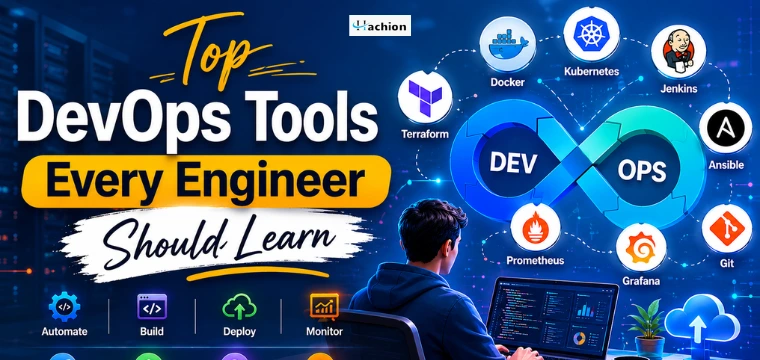
Top DevOps Tools Every Engineer Should Learn
The demand for DevOps professionals is growing rapidly as companies continue to adopt cloud computing, automation, and faster software delivery practices. Today, businesses want skilled engineers who can manage infrastructure, automate deployments, improve collaboration, and ensure continuous delivery of applications. As the IT industry continues to evolve, gaining knowledge of the right DevOps tools has become essential for professionals who want to grow and succeed in their technology careers.
Modern DevOps tools help organizations simplify development workflows, improve software quality, reduce deployment failures, and speed up application releases. From containerization to infrastructure automation, these tools are now used by startups, enterprises, and cloud-native companies worldwide. Engineers who understand these technologies can unlock better career opportunities and work on advanced cloud environments with confidence.
In this blog, we will explore some of the best DevOps tools every engineer should learn to stay competitive in the technology industry.
Why DevOps Tools Are Important
DevOps is more than just a development methodology. It is a culture that combines development and operations teams to improve collaboration and automation. Organizations use DevOps tools to automate repetitive tasks, monitor applications, manage containers, and deploy software efficiently.
These tools help teams:
- Improve software delivery speed
- Reduce manual errors
- Increase deployment reliability
- Manage cloud infrastructure effectively
- Enhance collaboration between teams
- Monitor applications in real time
As businesses continue moving toward cloud-native applications, DevOps knowledge has become one of the most valuable technical skills in the IT industry.
https://api.hachion.co/prod/upload_all_images/Cloud_Courses_Devops_Training_Devops_CTA.webp
Best DevOps Tools Every Engineer Should Learn
Docker
Docker is one of the most popular DevOps tools used for containerization. It allows developers to package applications and dependencies into lightweight containers that run consistently across different environments.
Docker simplifies application deployment and helps development teams avoid compatibility issues between systems. It is widely used in cloud computing, microservices architecture, and continuous deployment pipelines.
Key benefits of Docker:
- Faster application deployment
- Lightweight containers
- Improved scalability
- Better resource utilization
- Consistent development environments
Kubernetes
Kubernetes is an advanced container orchestration platform used to manage containerized applications at scale. It automates deployment, scaling, networking, and monitoring of containers.
Many organizations use Kubernetes to manage large cloud-native applications efficiently. It has become one of the most important technologies for DevOps and cloud engineers.
Why engineers should learn Kubernetes:
- Automatic scaling of applications
- High availability and reliability
- Efficient container management
- Simplified infrastructure operations
- Strong cloud-native ecosystem support
Jenkins
Jenkins is a leading automation server used for Continuous Integration and Continuous Deployment (CI/CD). It helps developers automate testing, building, and deployment processes.
Jenkins supports hundreds of plugins, making it flexible for different DevOps workflows and automation pipelines.
Advantages of Jenkins:
- Automates software delivery pipelines
- Reduces manual deployment work
- Supports multiple programming languages
- Easy integration with DevOps tools
- Improves software quality
Terraform
Terraform is widely used for Infrastructure as Code (IaC). It allows engineers to provision and manage cloud infrastructure using configuration files rather than manual setup.
Terraform supports major cloud platforms including AWS, Azure, and Google Cloud.
Benefits of Terraform:
- Automates infrastructure deployment
- Reduces configuration errors
- Supports multi-cloud environments
- Simplifies cloud resource management
- Improves scalability and consistency
Ansible
Ansible is a powerful automation tool used for configuration management, application deployment, and infrastructure provisioning.
It is known for its simplicity because it does not require agents to be installed on managed servers.
Key features of Ansible:
- Easy automation workflows
- Agentless architecture
- Simplified server management
- Fast deployment automation
- Efficient configuration management
Git
Git is one of the most essential tools for developers and DevOps engineers. It helps teams manage source code changes, collaborate on projects, and maintain version history.
Git plays a critical role in modern DevOps pipelines and software development workflows.
Why Git is important:
- Version control management
- Better team collaboration
- Faster code integration
- Improved project tracking
- Safe rollback options
Prometheus
Prometheus is widely used for monitoring applications and cloud infrastructure. It collects metrics and helps DevOps teams track application performance in real time.
Monitoring tools are important because they help organizations identify system failures before they affect users.
Benefits of Prometheus:
- Real-time monitoring
- Advanced alerting system
- Cloud-native support
- Easy integration with Kubernetes
- Improved system visibility
Grafana
Grafana is commonly used with Prometheus for data visualization and monitoring dashboards. It allows teams to create real-time analytics dashboards for applications and infrastructure.
Grafana helps engineers analyze system performance quickly and improve operational efficiency.
Features of Grafana:
- Interactive dashboards
- Real-time analytics
- Multiple data source integration
- Advanced monitoring visualization
- Better infrastructure insights
How DevOps Skills Improve Career Opportunities
Learning DevOps tools can significantly improve career opportunities in cloud computing, software development, and IT operations. Companies are actively hiring professionals with expertise in automation, CI/CD pipelines, Kubernetes, cloud infrastructure, and monitoring tools.
Popular DevOps job roles include:
- DevOps Engineer
- Cloud Engineer
- Site Reliability Engineer
- Automation Engineer
- Platform Engineer
- Kubernetes Administrator
Professionals with DevOps expertise often receive competitive salaries because organizations depend heavily on automation and scalable cloud infrastructure.
Build Your DevOps Career with Hachion Online Trainings
If you want to build a successful career in DevOps and cloud computing, practical training is extremely important. Hachion Online Trainings helps students and IT professionals learn industry-focused DevOps technologies through live online classes, real-time projects, and hands-on practical sessions.
The training programs cover:
- Docker and Kubernetes
- CI/CD pipelines
- Jenkins automation
- Terraform and Ansible
- Cloud infrastructure management
- AWS and DevOps integration
- Monitoring and deployment strategies
With expert mentors, flexible online learning, and project-based training, Hachion helps learners gain real-world DevOps skills that companies are actively looking for in the IT industry.
Conclusion
DevOps has become one of the most important technologies in modern software development and cloud computing. Organizations are using DevOps tools to automate workflows, improve software quality, and accelerate deployment processes.
Tools like Docker, Kubernetes, Jenkins, Terraform, Ansible, Prometheus, and Grafana are now essential for engineers who want to work in cloud-native environments and modern IT infrastructures.
Learning these DevOps tools can help professionals improve their technical skills, increase career opportunities, and stay competitive in the rapidly evolving technology industry. By gaining practical knowledge and hands-on experience, engineers can prepare themselves for high-demand roles in cloud and automation domains.
https://api.hachion.co/prod/upload_all_images/Cloud_Courses_Devops_Training_Bookyoursession.webp
Frequently Asked Questions (FAQs)
1. What are DevOps tools?
A: DevOps tools are software applications used to automate development, testing, deployment, monitoring, and infrastructure management processes in software development environments.
2. Which DevOps tool is best for beginners?
A: Docker and Git are often considered good starting points for beginners because they are easy to learn and widely used in the industry.
3. Why is Kubernetes important in DevOps?
A: Kubernetes helps organizations manage and scale containerized applications efficiently. It automates deployment, networking, and scaling processes in cloud environments.
4. What is the role of Jenkins in DevOps?
A: Jenkins is used for Continuous Integration and Continuous Deployment (CI/CD). It automates testing and software deployment pipelines.
5. Is DevOps a good career option?
A: Yes, DevOps is one of the fastest-growing career fields in IT because companies are increasingly adopting cloud computing, automation, and scalable infrastructure technologies.
6. Do DevOps engineers need coding skills?
A: Basic programming and scripting knowledge are helpful for DevOps engineers, especially for automation, infrastructure management, and CI/CD workflows.
7. How can I learn DevOps tools online?
A: You can learn DevOps tools through online training platforms, hands-on labs, certification programs, and real-time project-based learning offered by institutes like Hachion Online Training.


