
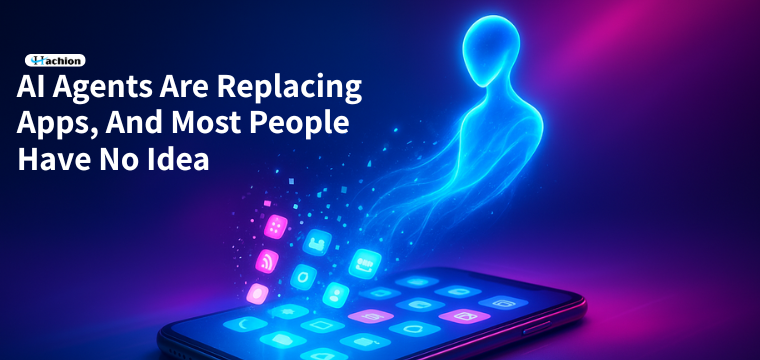
AI Agents Are Replacing Apps, And Most People Have No Idea
For more than a decade, apps ruled our digital lives. We downloaded them, organized them into folders, updated them every month, and learned how to use them one by one. But something unexpected happened in 2025. A quiet revolution started. Apps didn’t disappear, but the need to open an app for every small task began to fade. And the reason?
AI Agents.
Not chatbots.
Not voice assistants.
Not simple tools. Autonomous digital workers that can think, plan, make decisions, and complete tasks on their own. This shift is so big that people will look back and say, “2025 is when the app era started ending.” Let’s break it down, simply, clearly, and with real examples.
What Exactly Is an AI Agent?
Think of an AI Agent as a virtual employee living inside your device. You don’t type, open apps, or tap through menus. You tell it what you want, and the agent handles the entire process.
Example:
“Plan a weekend trip to Goa under ₹10,000 and book the hotel with the best reviews.” Instead of you checking MakeMyTrip, Airbnb, Skyscanner, Google reviews, weather, and dates.
Your AI Agent will:
It can look up flights or trains for you, compare the best hotels, find the right deals, check the weather, put together a full travel plan, book everything, send your tickets, and even set reminders without you doing a thing.
This is why experts say:
AI Agents aren’t apps. They are replacements for apps. Which Apps Are Already Being Replaced? This is not a prediction. Replacement has already begun.
Travel Apps (MakeMyTrip, Airbnb, Skyscanner)
People are no longer browsing endless travel pages.
They’re using AI agents like:
- Google Gemini Travel
- OpenAI Agentic Planner
- Booking.com AI Trip Planner
Real Example:
Users type: “Plan a 4-day family trip to Bali in March.” The agent returns flights, hotels, costing, and a sample itinerary in seconds. Travel apps are becoming backend engines. AI agents handle the front-end experience.
Shopping Apps (Amazon, Flipkart, Ajio)
AI shopping agents can now handle almost everything for you, from finding the right products and comparing prices to checking reviews, applying coupons, adding items to your cart, and even placing the order. Amazon’s Rufus AI already lets people shop just by having a conversation instead of typing searches. You don’t scroll anymore; you simply tell it what you want, and it takes care of the rest.
Food Delivery Apps (Swiggy, Zomato, Uber Eats)
Your AI Agent can take your mood and health into account:
- “Order something light, vegetarian, under 400 calories.”
- And your food arrives, without you opening anything.
- DoorDash already uses AI agents to recommend, compare, and customize orders.
- This is happening worldwide.
Banking Apps
Soon, you won’t be “checking your balance” or “tracking your expenses.” AI agents will:
- Pay your bills
- Identify fraud
- Build budgets
- Invest automatically
- Send reminders
- Negotiate credit card interest
- Manage subscriptions
In the US, Klarna’s AI agent already reduced manual customer service calls by 80%.
Work & Productivity Apps (Notion, Slack, Trello, Asana)
Your AI agent at work will soon:
- Write emails
- Schedule meetings
- Take notes
- Assign tasks
- Follow up with teams
- Prepare presentations
- Respond to clients
Microsoft’s 2025 Copilot update introduced workflow agents that manage end-to-end tasks without human involvement. These aren’t “assistants. They’re digital coworkers.
Why Is This Shift Happening?
1. People want outcomes, not apps: Nobody wants to open 10 different apps. People want a result, quickly. AI Agents deliver outcomes, not interfaces.
2. App fatigue is real: The average person uses 40+ apps weekly. It’s exhausting. AI agents reduce everything to one conversation.
3. Devices are becoming “smarter layers.”: Your phone is no longer the hero. Your AI intelligence layer is. Your device won’t wait for your input. It will predict what you need.
4. Businesses want automation: Companies want fewer tools and more output. AI agents reduce repetitive work by 50–70% across:
- HR
- Marketing
- Customer support
- Sales
- Finance
- Operations
- This saves money, time, and manpower.
The Biggest Tech Shift: From Apps → Autonomous Agents
For 15 years, tech was app-centric. From 2025 onwards, tech becomes agent-centric. Old World New World
- You open apps, and Agents act automatically
- You search, Agents predict your needs
- You compare options, and agents choose the best
- You jump between tools. One AI layer controls everything
- Apps = tools Agents = digital workers
This shift is as powerful as:
- Websites → Mobile apps
- SMS → WhatsApp
- Cash → UPI
- Manual work → Automation
Now:
App usage → Agent-driven automation. A permanent change.
How 2026 Will Look
1. Your phone's home screen becomes an AI dashboard
You won’t see 40 app icons. You’ll see a single AI interface.
2. App Stores shrink
Developers will build AI workflows instead of separate apps.
3. Jobs will transform
Employees who know how to use AI agents will grow. Those who don’t will struggle.
4. Customer support becomes 80% automated
AI agents will answer calls, emails, and chats.
5. End-to-end workflows will run on their own
Recruitment, marketing, analytics, and finance are all automated.
6. New AI careers will rise
- AI Agent Developer
- Workflow Automation Specialist
- AI Product Strategist
- Prompt Architect
- AI Adoption Consultant
- 2026 will reward people who embrace AI agents early.
Industries Already Using AI Agents
This shift has already started in:
Healthcare: AI books doctors, checks symptoms, and monitors reports automatically.
E-Commerce: Personal AI shoppers handle browsing and decision-making.
Banking: Automated financial advisors manage spending and investments.
Education: AI tutors teach students 1:1 at their own pace.
Recruitment: Agents screen resumes and schedule interviews end-to-end.
Marketing: AI creates posts, ads, captions, emails, and even runs campaigns. This is not “future tech.” This is a 2025 reality.
FAQ’s
1. Are AI agents really replacing apps?
A: Yes. Many tasks that required individual apps can now be handled by a single AI agent using automation and reasoning.
2. Which apps will be replaced first?
A: Travel apps, shopping apps, food delivery apps, note-taking apps, and financial management tools are the first to shift.
3. Why are AI agents becoming so popular?
A: They reduce effort, save time, eliminate app fatigue, and deliver ready-made outcomes instead of making users search manually.
4. Will AI agents eliminate jobs?
A: Not completely. But people who don’t know how to use or build agents may get replaced by those who can.
5. How do AI agents work?
A: They combine LLMs, memory, automation, reasoning, and APIs to perform tasks independently.
6. What is the difference between an AI assistant and an AI agent?
A: Assistants respond. Agents act booking, ordering, planning, writing, and deciding.
7. How will AI agents affect daily life by 2026?
A: Bill payments, travel planning, emails, shopping, scheduling, everything will be handled automatically.
8. Which companies are building AI agents?
A: OpenAI, Google, Meta, Amazon, Microsoft, DoorDash, Uber, Airbnb, Klarna, Swiggy, and many startups.
9. Are AI agents safe for personal data?
A: Yes, as long as permissions are managed properly. Users can control actions, payments, and data access.
10. How can I learn to use or build AI agents?
A: By learning AI, automation, prompt engineering, and LLM workflows through a practical training program.
Want to Build AI Agents Yourself?
2025–2026 will be the year when AI skills decide career growth. If you want hands-on training in the following technologies:
- LLMs
- AI agents
- Real automation workflows
- Industry projects
- Job support
👉 Enroll in Hachion’s AI & other Courses. A future-proof program designed to help you stay ahead in a world where AI Agents rule the digital landscape.
Conclusion
AI Agents aren’t just another tech trend; they’re a complete shift in how we will use technology. Instead of opening different apps for every task, we’ll soon rely on one intelligent agent that plans, organizes, and handles things for us. This change has already started, and by 2026, it will become a normal part of everyday life. People who understand how to use and build AI agents will stay ahead. Those who don’t will fall behind. If you want to prepare for this new future, now is the right time to start learning.


