
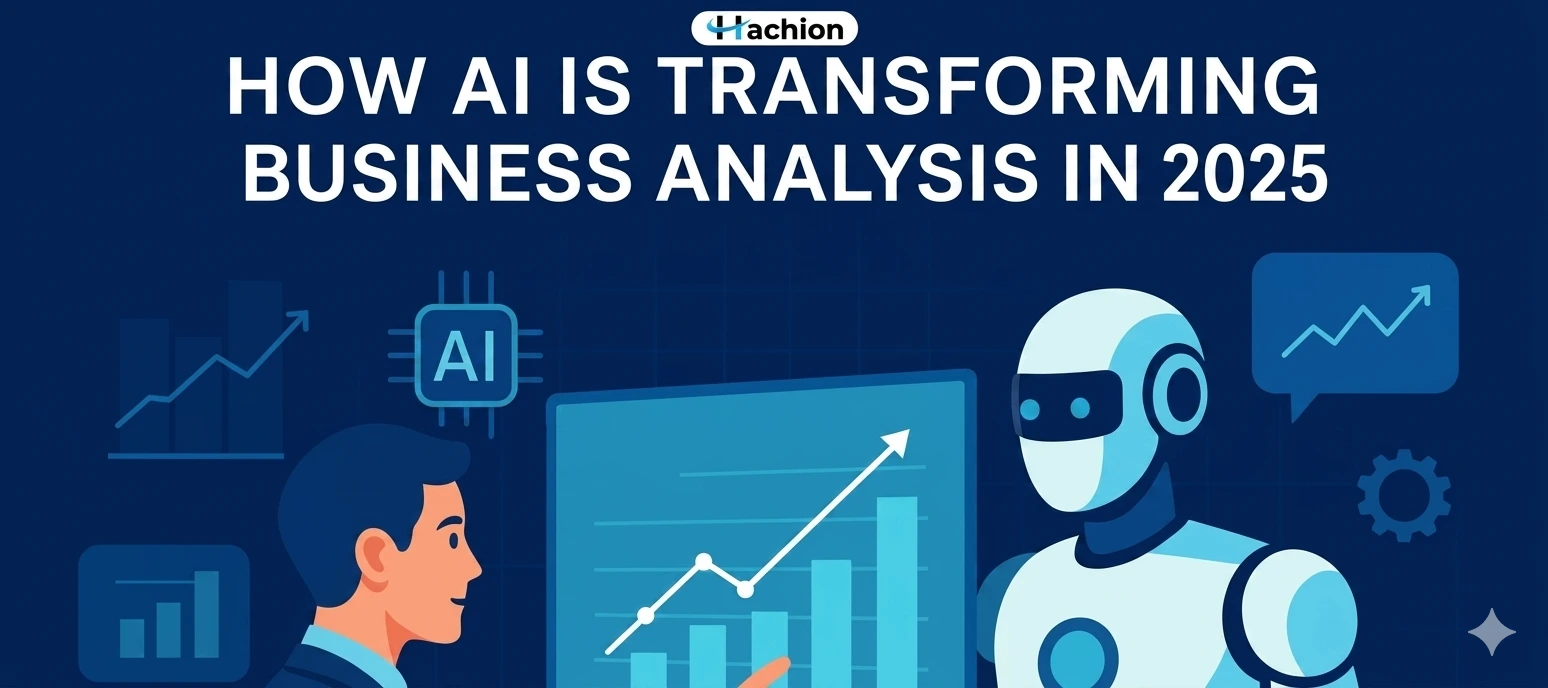
How AI Is Transforming Business Analysis in 2025
The business environment today is changing very rapidly, and a decision is no longer taken on a gut feeling; it is made on data. In the case of retail and healthcare, businesses currently require the services of business analysts who can transform huge volumes of data into actionable information. The job description of the data-driven business analyst is also changing fast as artificial intelligence (AI) keeps improving.
This blog examines the definition of data-driven business analysis, the work of business analysts, the challenges business analysts address, the transformations occurring in the field due to AI, and the importance of 2025 as the time to upgrade your skills as a business analyst by enrolling in the Business Analyst Program at Hachion.
Introduction: What Is Data-Driven Business Analysis?
The whole concept of data-driven business analysis consists of deriving decisions based on data. Business analysts now apply structured data (databases, analytics programs, reports) and unstructured data (social media, customer ratings, and sensors) to find patterns, forecast the results, and suggest the most appropriate course of action.
A Business analyst who is data-driven is actually a conduit between raw data and strategic decisions.
Their job involves:
- Collection and refurbishment of business data.
- The visualization of trends with the help of analytical tools (such as Power BI, Tableau, or Excel).
- Analyzing findings within the business objectives.
- Delivering insights to the management in a straightforward, practical manner.
- Using evidence to recommend process, products, or new strategies.
- As an example, customer buy data can help an analyst at an e-commerce firm to make personalized product recommendations or to optimize marketing budgets.
- The reason Data is more important than ever.
All organizations are becoming data-first in 2025. Gartner reports that data-driven decision-making is of first business importance in more than 90 percent of companies. Being able to transform numbers into stories is a superpower.
However, raw data is not sufficient. And in the absence of experienced business analysts, data will be numbers. That is why business analysts who are powered by data are in high demand- they do not merely gather data, they transform it into action.
Marketable Competencies of an Analyst: Data.
The business analysts must have both technical and business skills to excel in this changing field:
1. Analytical Thinking
It is vital to have the capacity to perceive patterns, trends, and sense complex information.
2. Technical Proficiency
Data visualization instruments such as Power BI, Tableau, Excel, and database (or SQL) knowledge assist analysts in making appropriate dashboards.
3. Communication and Storytelling.
Data insights do not work unless properly communicated. The professional analyst is one who narrates a story that is supported by facts.
4. Domain Knowledge
Knowledge of the business context, finance/ retail/ IT/ healthcare, assists in aligning knowledge with objectives.
5. Adaptability to AI Tools
Repetitive analysis is being automated in artificial intelligence-based platforms in 2025. Business analysts should be aware of how to work with them instead of feeling scared.
Problems in Data-Driven Business Analysis.
The best analysts even have to encounter challenges in dealing with real data. We will examine some of the largest challenges and solutions to these challenges.
1. Data Quality Issues
Issue: Poor decisions are a result of poor data that is inconsistent, incomplete, or outdated.
Recommendation: Implement effective data governance policies and apply AI-driven data cleaning software, which is capable of automatically identifying and fixing anomalies.
2. Data Silos
Issue: Separatism of departments has led to the problem of different departments holding on to their data, and it is difficult to get an overview of the business.
Solution: Enhance the data incorporation by means of centralized cloud-based data warehouses and lead the cooperation between different departments.
3. Misinterpretation of Data
Issue: The analysts can make misleading conclusions because of inappropriate context or prejudice.
Remedy: Quantitative analysis should be supplemented with qualitative understanding, and there should always be a number of other data sources to prove the assumptions.
4. Overdependence on Tools
Issue: A significant number of analysts tend to depend too much on dashboards without knowing the business logic.
Solution: Bear in mind that tools are helpful for thinking; however, experience and human judgment are sources of strategic reasoning.
5. Security and Privacy Issues.
Issue: As the amount of data expands, it becomes difficult to protect confidentiality and face the requirements such as the GDPR.
Resolution: Adopt security measures on data management, and closely collaborate with compliance offices to promote ethical use of data.
The Revolution in Business Analysis using AI.
Artificial Intelligence is not a futuristic concept anymore, but a mainstream concept. The use of AI in the year 2025 is not going to render business analysts useless; it is going to enable them.
Here’s how:
1. Robotizing Data Collection and Cleaning.
AI has the capability to collect, combine, and purify data across numerous sources automatically. Analysts are able to save time and are able to concentrate on strategic information rather than on manual tasks.
2. Predictive and Prescriptive Analytics.
Machine learning models can now assist an analyst in predicting trends- such as sales, churn rates, or customer satisfaction months before they happen. This enables the businesses to take action before a crisis arises.
3. Natural Language Processing (NLP)
Artificial Intelligence devices are able to scan the reviews of thousands of customers or social media comments and condense the emotions in real time, providing analysts with information on what people think in real time.
4. Decision Intelligence
Dashboards based on AI do not display numbers, but they give recommendations. As an example, when the profits decline, the system may recommend reducing the prices in certain areas or focusing on new groups of customers.
5. Business Chatbots based on AI.
Now, analysts are able to communicate with AI assistants that immediately draw reports, visualize data, or simulate a result given a hypothetical situation. To the point, AI complements human intelligence; in other words, it increases the accuracy, speed, and confidence of business decision-making.
The Future of 2025 Business Analysis.
The business analyst is changing his or her role from a report generator into a strategic decision partner. With AI and automation assuming repetitive analysis roles, more emphasis will be placed on the human analysts:
- Learning the business objectives.
- Considering the ethical moments of AI decisions.
- Sharing wisdom in a manner that makes sense.
- Transforming data into innovation.
The business of technology is not only one of the most promising careers of the decade, but it is also actively sought by companies that seek analysts who are familiar with technology and business. Indeed and LinkedIn job data show that the number of roles requiring data-driven and AI skills in the role of a business analyst has increased annually over the past 25 years annually since 2023 and the number keeps increasing.
How and Why to Be a Data-Driven Business Analyst.
When you are willing to go into this future, here is your roadmap:
- Establish a background in the concepts and frameworks of business analysis (BABOK, Agile, SDLC).
- Become acquainted with such data tools as Power BI, Tableau, Excel, and SQL.
- Learn AI principles, predictive analytics, the basics of machine learning, and data ethics.
- Do real-world projects involving business cases with data intelligence.
- Obtain certification or training from an industry-approved course.
- Take the Business Analyst Program of Hachion.
- Hachion has one of the most pragmatic industry-oriented Business Analyst Programs that are offered to beginners and professionals alike.
That is why thousands of learners believe Hachion:
- Projects in real-time and according to the needs of the market.
- Advice on solutions provided by industry leaders who have worked in business and AI analytics.
- Practical learning in Power BI, SQL, Excel, and visualization.
- Interview and portfolio career mentoring.
It does not matter whether you are a freshman who wants to be in the sphere of business analysis or a professional and wants to enrich your career with AI and data-based skills; the Business Analyst Program offered by Hachion is the next step in your life.
👉 Join now and transform your critical thinking into a high-paying career in 2025 and beyond.
FAQ’s
1. What is business analysis that is driven by data?
A. Data-driven business analysis refers to the procedure of applying data in making all business decisions rather than basing them on intuition or assumptions. Business analysts collect, clean, and understand data to identify trends, give predictions, and prescribe measures that are consistent with organisational objectives.
2. What will AI do to business analysis in 2025?
A. With AI, business analysis is changing the way business is done in 2025 through automation of repetitive business processes such as data collection, cleaning, and reporting. It facilitates predictive analytics, real-time, and decision intelligence, assisting business analysts in creating quicker and clever proposals. AI serves as a strategic assistant to replace analysts, but it does not eliminate them; it increases accuracy and productivity.
3. What will a data-driven business analyst need?
A: An effective data-driven business analyst of 2025 must:
- Critical thinking and problem-solving skills.
- Technical skills in such tools as Power BI, Tableau, and SQL.
- Ability to communicate and tell stories to share insights.
- Knowledge of AI and ideas of data science.
- Financial, medical, IT, or retail domain knowledge.
4. What are the key issues of data-driven business analysis?
A: The most common challenges are low data quality, siloing of data in individual departments, security and privacy concerns, and excessive reliance on tools. There is also a risk of misinterpreting data without the appropriate context by the analysts. These obstacles could be addressed using the means of data governance, cloud integration, and AI-driven automation solutions.
5. How can AI solve the issue of data?
A: AI aids in cleaning and structuring data automatically, identifying mistakes, and offering more significant insights into predictive and prescriptive analytics. It has even the ability to analyze customer sentiment through natural language processing (NLP) and give recommendations with the help of decision intelligence tools, making data analysis quicker, more precise, and actionable.
6. Why then would 2025 be the best time to become a business analyst?
A: As AI and data become relevant to every industry, the need for technology-savvy business analysts will be the highest in 2025. Finance, retail, and technology organizations are seeking individuals with the ability to integrate business strategy with analytical capabilities. It is a future-proof profession with a high increase in salaries and a global outlook.
7. What can I do to be a data-driven business analyst?
A: To become a data-driven business analyst, you are expected to:
Study business analysis models such as Agile, SDLC, and BABOK.
- Dominate Power BI, Tableau, Excel, and SQL.
- Learn the fundamentals of machine learning, predictive analytics, and AI.
- Real-life case studies and live work.
Take a professional course in Business Analysis, such as the Business Analyst Program at Hachion, in order to acquire some hands-on experience.
8. Differentiated by Hachion Business Analyst Program?
A: Hachion has a practical business analyst course that is industry-positioned and merges data analytics, artificial intelligence applications, and visualization software. Students acquire project experience and mentoring by industry professionals and are coached on interviews and career growth, which makes it perfect not only for novices but also for professionals.
9. Is AI technology displacing business analysts?
A: No. AI technology is not eliminating business analysts- it is enabling them. AI automates data processing that involves routine, but human analysts have critical thinking, creativity, and contextual understanding, which machines do not. Human-AI collaboration is the future of business analysis.
10. What is the business analyst's average wage in 2025?
A: Based on the available trends, the median income of a data-driven business analyst in 2025 in India is 84,000- 12,000 INR per annum, and in the U.S, it is 75- 105,000 USD per annum, depending on experience and skills, and specialization in a certain industry. AI and data analytics specialists make more on the high side.
11. Why is a data-based strategy better at enhancing business?
A: A data-driven strategy assists organizations in minimizing risks, predicting new trends, improving customer experience, and streamlining operations. The fact that every decision is made with references to data makes companies more agile, competitive, and innovative.
12. What is the best place to begin data-driven business analysis with Hachion?
A: You can start your career by joining the Business Analyst Program at Hachion. It includes data visualization and analytics solutions to AI integration and real-world project simulations, all the skills needed to be a confident, data-driven professional in 2025 and beyond are included in the course.
👉 [Register in the Business Analyst Program of Hachion] and make a move towards a promising and fulfilling future.
Final Thoughts
Data will no longer be an asset in 2025; it is the blood of every thriving company. And is it that there is, behind all clever business decisions, a business analyst who is a data man, who knows how to integrate numbers with stories?
Intelligence may alter our instruments, but the human element, critical thinking, empathy, and communication, will make great analysts always.
If you are willing to determine the future of decision-making, you'd better learn and adapt, and enroll in the Business Analyst Program by Hachion to future-proof your career.


