
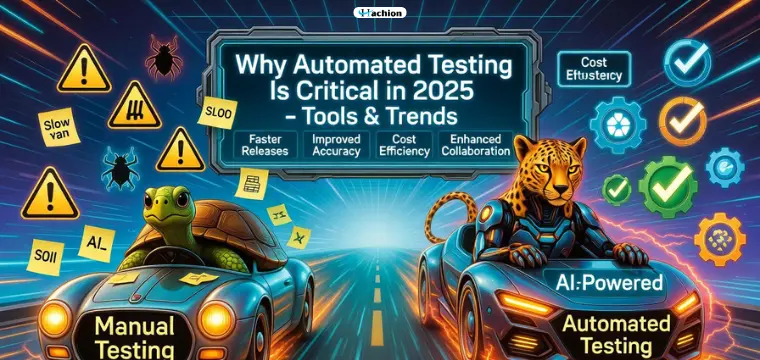
Why Automated Testing Is Critical in 2025: Tools & Trends
Things are going at a faster pace in technology in 2025. The companies are publishing new apps, features, and updates nearly every week. This world of competition cannot do without manual testing. Speed, accuracy, and reliability are essential to businesses, and sure enough, that is the reason Automated Testing is becoming an indispensable part of software development.
Automated testing is no longer regarded as an additional privilege today. It is an essential condition for any technological team that wishes to provide high-quality products, minimize errors, and stay ahead of its competitors. Let’s break it down.
What Is Automated Testing and Why Is It So Important?
Automated testing involves the use of software to execute the test cases automatically, as opposed to manually implementing every step by a human tester. This helps teams:
- Detect bugs faster
- Deliver updates quickly
- Improve app performance
- Reduce human errors
- Save time and cost
As the number of people requiring mobile applications, cloud services, and AI-driven services is growing in 2025, automated testing is the pillar of any modern development cycle.
Recent Development in Automated Testing 2025
AI-powered Test Automation: Automation is being changed by Artificial Intelligence. AI tools can now identify the potential risk areas in the code. Auto-generate test scripts, Self-heal broken scripts, and enhance coverage automatically. Such tools as Testim, Mabl, and Katalon AI are gaining popularity in the industry.
Low-Code / No-Code Test Automation: There is no longer a requirement for teams to have deep knowledge of coding in order to write tests. With low-code tools, QA engineers are able to drag and drop test steps. Simple construction of cross-browser tests. Automation should be performed in hours, not days. This enables even the non-technical testers to contribute.
Mobile Test Automation is on Fire: Mobile app testing has become a necessity as mobile apps take over the business. In 2025, companies are focusing on Multi-device testing, Performance testing, app security checks, and Real-device cloud testing. Such tools as Appium, BrowserStack, and Lambda Test are facilitating the implementation of an impeccable user experience.
Cloud-Based Testing: Test on Cloud testing platforms enable the team to test on 1000+ devices, Multiple browsers, and all OS versions. This is so that your application can be used everywhere, anywhere.
Shift-Left Testing: Earlier in the development life cycle, developers test not when everything has been built. This saves bugs towards the end and delivers faster.
API & Microservices Testing: The applications used now are based on APIs and microservices. API testing is used to ensure fast performance, secure data communication, and seamless interconnection of services.
2025 Tools Popular as Automated Testing
The most popular tools in the industry are as follows:
- Selenium: The leading automation tool of web testing in the world.
- Appium: The foremost automation tool for mobile apps testing (Android and iOS).
- Cypress: Famous for quick and efficient front-end testing.
- Playwright: Bringing awareness to cross-browser end-to-end testing.
- Katalon Studio: An advanced single platform of automation.
- Robot Framework: A keyword-based tool that is well-suited to enterprise-level testing.
- Postman / Karate: API testing favorites.
The tools assist the QA teams to work in a smart, quicker, and efficient manner. Some of the ways that Automated Testing enhances user experience have been explained.
The modern users desire applications that are:
- Fast
- Reliable
- Bug-free
- Smooth to navigate
- Beautifully designed
- Secure
Auto-testing makes sure your application:
- Loads quickly
- Works on all devices
- Handles thousands of users
- Has no broken pages
- Not susceptible to any vulnerabilities.
This has a direct positive impact on enhancing user satisfaction and retention, which is very important in the competitive digital world in 2025.
Challenges of Automation Testing and Solutions
Although automated testing is strong, certain issues are encountered by teams:
High initial setup time
Solution: Low-code tools minimize the setup and code.
Script maintenance
Solution: AI-based testing programs automatically fix broken tests.
Multiple device/browser testing.
Solution: Thousands of environments are offered on cloud testing platforms.
Skilled QA resources
Resolution: Testers can be developed with solution-based training and upskilling programs (such as Hachion!).
Who requires Automated Testing:
Automated testing is an important career requirement, particularly among:
- Manual testers
- QA engineers
- DevOps professionals
- Software developers
- Freshers entering IT
- Every person who switched jobs to technology.
The workload is large, wages are increasing, and employers are willing to hire testers who are familiar with automation resources.
Find out how you can study automated testing. Enroll in Hachion Today for the QA Automation online Training course.
This is the best moment to upskill if you are planning to be a skilled Automation Tester in 2025. At Hachion, you can learn:
- Selenium
- Appium
- Cypress
- Playwright
- API Testing
- Test Automation Frameworks
- CI/CD (Jenkins, GitHub Actions)
- Real-time projects
- Interview preparation
You will have practical experience, professional mentoring, and portfolio project training that will see you score the best IT jobs. Level up your career with Hachion. Your future in Automation Testing begins here!
FAQ’s
1. What is automated testing, and how does it work?
A: Automated testing uses specialized software to execute test cases without human intervention. The tools simulate user actions, check application behavior, and compare the results with expected outcomes. This helps teams test faster, more accurately, and more efficiently.
2. Why is automated testing becoming essential in 2025?
A: In 2025, companies deploy updates more frequently and expect rapid development cycles. Automated testing reduces manual effort, speeds up release timelines, prevents costly bugs, and ensures high-quality user experiences across web, mobile, and cloud platforms.
3. What are the most popular automated testing tools today?
A: Some widely used tools include:
- Selenium (web testing)
- Appium (mobile testing)
- Cypress (front-end testing)
- Playwright (cross-browser automation)
- Katalon Studio (low-code automation)
- Postman / Karate (API testing)
These tools support modern applications built with AI, microservices, and cloud technologies.
4. Can automated testing fully replace manual testing?
A: No. Automated testing improves speed and accuracy, but manual testing is necessary for:
- Usability checks
- Exploratory testing
- Visual validation
A balanced combination of both is used in most organizations.
5. What skills are required to start automation testing?
A: Beginners should learn:
- Basics of QA
- One programming language (Python, Java, or JavaScript)
- Tools like Selenium, Appium, or Cypress
- API testing
- Git and CI/CD pipelines
These skills help you become job-ready in automation.
6. Is automated testing suitable for beginners?
A: Yes, absolutely. Many automation tools now include low-code and AI-assisted features. Even manual testers or non-technical learners can start automation with the right training and practice.
7. What challenges do teams face in automated testing?
A: Common challenges include:
- Maintaining test scripts
- Handling dynamic UI elements
- Test flakiness
- Device/browser compatibility
- High initial setup time
Modern AI-based tools help reduce these challenges.
8. How does automated testing improve mobile app performance?
A: Automated testing checks mobile apps across multiple devices, networks, and OS versions. It helps identify crashes, slow performance, broken features, UI bugs, and security issues, resulting in a smoother user experience and higher app ratings.
9. Is automation testing a good career in 2025?
A: Yes! Automation testers are in high demand globally. Companies prefer professionals who can build automation frameworks, improve quality, and speed up development. The field offers strong salaries, growth potential, and long-term career stability.
10. Where can I learn automation testing with real-time projects?
A: You can join Hachion, where you’ll learn:
- Selenium
- Appium
- Cypress
- Playwright
- API Automation
- Framework building
- CI/CD pipelines
Hachion provides hands-on training, industry-targeted curriculum, and real projects to help you become a skilled automation tester.
https://api.hachion.co/prod/upload_all_images/QA_Testing_QA_Automation_(Selenium_with_Java)_QAw.webp
Conclusion
Automated testing has become essential in 2025 as companies move faster and expect higher-quality software. It helps teams find issues early, deliver updates quickly, and ensure a smooth user experience across all devices. While automation comes with challenges, the right tools, skills, and strategies make the process easier and more effective. For anyone aiming to grow in the tech industry, learning automation testing is a smart and future-proof choice.


