
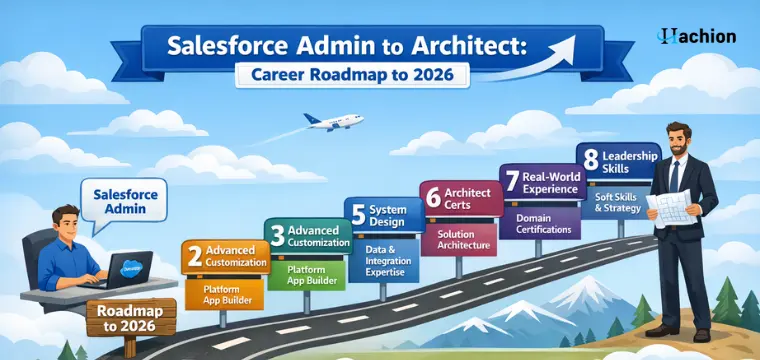
Salesforce is one of the most in-demand platforms in the world. Many professionals start their journey as a Salesforce Administrator, but over time they want to grow into a Salesforce Architect role. This transition is a powerful career move because architects are responsible for designing large-scale Salesforce solutions for businesses.
If you are currently a Salesforce Admin and want to become a Salesforce Architect, this roadmap will help you understand the skills, certifications, and experience needed to reach your goal in 2026.
Why Move from Salesforce Admin to Salesforce Architect?
A Salesforce Admin manages the daily operations of a Salesforce system, while a Salesforce Architect focuses on designing complex solutions that align with business goals.
Here are a few reasons why many professionals aim to become architects:
- Higher salary opportunities
- Leadership and decision-making roles
- Work on enterprise-level Salesforce implementations
- Increased demand across industries
- Opportunity to influence system design and strategy
In 2026, companies are looking for professionals who can not only manage Salesforce but also design scalable and secure systems.
Step 1: Build a Strong Salesforce Admin Foundation
Your journey starts with mastering the Salesforce Administrator role. Before moving toward architecture, you must deeply understand how Salesforce works.
Key skills to master:
- User management and security
- Profiles, roles, and permission sets
- Reports and dashboards
- Data management and data quality
- Workflow rules, Process Builder, and Flow
- Standard and custom objects
Spend time working on real-world Salesforce projects. Practical experience helps you understand business requirements and how Salesforce solutions are implemented.
Recommended certification:
- Salesforce Certified Administrator
This certification proves that you understand core Salesforce platform capabilities.
Step 2: Learn Salesforce Platform Customization
After gaining experience as an Admin, the next step is learning advanced customization.
Salesforce Architects must know how to extend the platform to solve complex business problems.
Important topics to learn:
- Advanced Flow automation
- Lightning App Builder
- Schema design and data modeling
- Validation rules and formula fields
- Custom applications
At this stage, you should start thinking like a solution designer, not just a system administrator.
Recommended certifications:
- Salesforce Advanced Administrator
- Salesforce Platform App Builder
These certifications demonstrate your ability to customize Salesforce effectively.
Step 3: Understand Salesforce Development Basics
Even though architects do not always write code, they must understand Salesforce development concepts.
This knowledge helps you communicate with developers and design better technical solutions.
Key development topics include:
- Apex basics
- Lightning Web Components (LWC)
- API integrations
- Data migration strategies
- Testing and deployment
You do not need to become a full developer, but understanding these technologies is very important for architectural decisions.
Recommended certification:
- Salesforce Platform Developer
Step 4: Gain Experience with Integrations and Data Architecture
A Salesforce Architect often works with multiple systems. Businesses connect Salesforce with ERP systems, marketing platforms, payment systems, and more.
This is why integration knowledge is critical.
Important skills to develop:
- REST and SOAP APIs
- Middleware tools
- Data synchronization
- Event-driven architecture
- External data sources
You should also learn about data architecture, including:
- Data governance
- Data security
- Data modeling best practices
- Large data volume management
Relevant certifications:
- Salesforce Data Architect
- Salesforce Integration Architect
These certifications are part of the Salesforce Architect journey.
Step 5: Learn System Design and Architecture Principles
At this stage, your focus shifts from configuration to system design.
Architects must design systems that are:
- Scalable
- Secure
- Maintainable
- High performance
Important architecture concepts include:
- Enterprise architecture patterns
- Security architecture
- Identity and access management
- Multi-org strategies
- Performance optimization
You should also start learning solution design documentation, such as:
- Architecture diagrams
- Data flow diagrams
- Integration design documents
Step 6: Earn Salesforce Architect Certifications
Certifications play an important role in proving your architectural expertise.
Key certifications for the Salesforce Architect path include:
Domain Architect Certifications
- Data Architect
- Sharing and Visibility Architect
- Integration Architect
- Identity and Access Management Architect
- Development Lifecycle and Deployment Architect
After completing these certifications, you can work toward the Salesforce Application Architect or System Architect credentials.
The final milestone is the prestigious Salesforce Certified Technical Architect (CTA) certification, which is one of the most respected credentials in the Salesforce ecosystem.
Step 7: Gain Real-World Architecture Experience
Certifications are important, but real-world experience is essential.
Try to gain experience in:
- Large Salesforce implementations
- Multi-cloud environments
- Complex integrations
- Data migration projects
- Performance optimization
You can build experience by:
- Working on enterprise projects
- Participating in Salesforce community projects
- Contributing to solution design discussions
- Mentoring junior admins
Hands-on experience will help you think like a true architect.
Step 8: Build Soft Skills and Leadership
Salesforce Architects do more than design systems. They also work closely with stakeholders, business leaders, and development teams.
Essential soft skills include:
- Communication skills
- Problem-solving ability
- Business analysis
- Leadership and mentoring
- Strategic thinking
Architects must translate business requirements into technical solutions, which requires both technical and communication skills.
Tools and Resources to Learn Faster
To accelerate your journey, you can use the following resources:
- Salesforce Trailhead
- Salesforce Developer Documentation
- Salesforce Community Groups
- Salesforce Architect Guides
- Hands-on sandbox practice
Continuous learning is important because Salesforce releases new features three times every year.
Salesforce Architect Salary in 2026
One major reason professionals move toward architecture is the salary growth.
Average global salaries for Salesforce Architects in 2026:
- India: ₹30L – ₹70L per year
- United States: $140K – $200K per year
- Europe: €90K – €150K per year
The demand for skilled Salesforce Architects continues to grow as more companies adopt Salesforce for digital transformation.
Final Thoughts
Moving from a Salesforce Admin to a Salesforce Architect is a challenging but rewarding career path. The journey requires strong technical knowledge, real-world experience, and continuous learning.
By following this roadmap, gaining certifications, and building practical experience, you can successfully transition into a Salesforce Architect role by 2026.
Start with a strong admin foundation, expand your technical skills, learn system design, and gain architecture-level experience. With dedication and the right strategy, you can become a highly respected Salesforce Architect in the global tech industry.


