
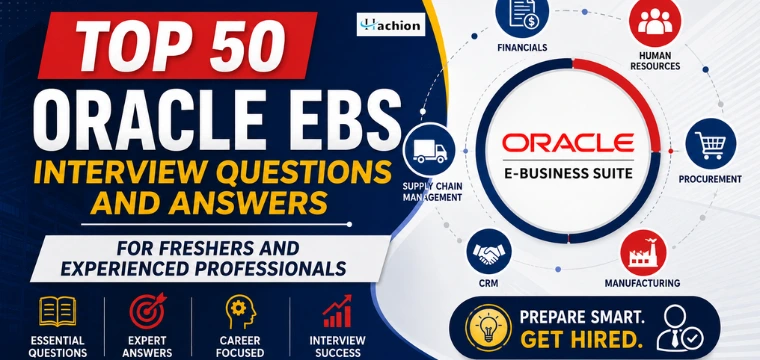
Top 50 Oracle EBS Interview Questions and Answers
Oracle EBS Interview Questions and Answers are among the most searched topics by professionals preparing for Oracle ERP-related roles. Whether you are a fresher looking for your first Oracle job or an experienced consultant planning a career move, understanding the most common interview questions can significantly improve your confidence and performance.
Oracle EBS Interview Questions and Answers help candidates understand the core concepts of Oracle E-Business Suite, including its architecture, modules, implementation processes, and technical components. Employers often assess both theoretical knowledge and practical experience, making interview preparation an essential step toward securing a rewarding position.
Oracle EBS Interview Questions and Answers Guide
Oracle E-Business Suite (Oracle EBS) is one of the world's leading enterprise resource planning (ERP) solutions. It helps organizations manage finance, supply chain, procurement, human resources, manufacturing, and customer relationships through an integrated platform.
Companies across industries continue to rely on Oracle EBS for business process management, creating strong demand for skilled professionals, functional consultants, developers, administrators, and support engineers.
Below are some of the most frequently asked Oracle EBS interview questions.
https://api.hachion.co/prod/upload_all_images/Cloud_Courses_Oracle_EBS_Training_OracleEBS_CTA.webp
1. What is Oracle EBS?
A: Oracle EBS is a comprehensive suite of integrated business applications that helps organizations automate and manage various business functions.
2. What are the major modules in Oracle EBS?
A: The major modules include:
- Financials
- Supply Chain Management (SCM)
- Human Capital Management (HCM)
- Customer Relationship Management (CRM)
- Procurement
- Manufacturing
3. What is Oracle Apps?
A: Oracle Apps is another commonly used name for Oracle E-Business Suite.
4. What is Oracle EBS R12?
A: Oracle EBS R12 is a major release that introduced enhanced functionality, improved integration, and better financial management capabilities.
5. What is Multi-Org Architecture?
A: Multi-Org Architecture allows organizations to manage multiple business units within a single Oracle EBS instance.
6. What is a Responsibility in Oracle EBS?
A: A responsibility defines the menus, forms, reports, and data access available to a user.
7. What is a Concurrent Program?
A: A concurrent program is used to execute reports, data processing tasks, and background jobs.
8. What is a Concurrent Manager?
A: The Concurrent Manager schedules and executes concurrent requests.
9. What is a Request Set?
A: A Request Set allows multiple concurrent programs to run in a predefined sequence.
10. What is a Value Set?
A: A Value Set controls the values entered into Oracle forms and reports.
11. What is a Flexfield?
A: Flexfields allow organizations to customize Oracle applications without modifying source code.
12. What are Key Flexfields?
A: Key Flexfields are used to identify business entities such as accounts and assets uniquely.
13. What are Descriptive Flexfields?
A: Descriptive Flexfields capture additional user-defined information.
14. What is a Profile Option?
A: Profile Options control application behavior and user preferences.
15. What is Oracle Workflow?
A: Oracle Workflow automates business processes and approvals.
16. What is AOL?
A: AOL stands for Application Object Library and provides common application services.
17. What is a Form Personalization?
A: Form Personalization enables customization of Oracle forms without modifying standard code.
18. What is a Responsibility Assignment?
A: It is the process of assigning specific responsibilities to users.
19. What is a Ledger?
A: A Ledger is the primary accounting record used in Oracle Financials.
20. What is Subledger Accounting?
A: Subledger Accounting creates accounting entries from operational transactions.
21. What is Oracle SCM?
A: Oracle SCM manages supply chain activities including procurement and inventory.
22. What is an Inventory Organization?
A: It represents a facility where inventory transactions are managed.
23. What is Procure-to-Pay Cycle?
A: It covers purchasing goods through payment processing.
24. What is an Order-to-Cash Cycle?
A: It includes receiving customer orders through payment collection.
25. What is AutoInvoice?
A: AutoInvoice imports customer transaction data into Oracle Receivables.
26. What is AutoAccounting?
A: AutoAccounting automatically generates accounting distributions.
27. What is MOAC?
A: MOAC stands for Multi-Org Access Control and allows access across multiple operating units.
28. What is XML Publisher?
A: XML Publisher is used for generating customized reports and documents.
29. What is Discoverer?
A: Discoverer is a reporting and business intelligence tool.
30. What is Oracle Alerts?
A: Oracle Alerts provide automated notifications based on business events.
31. What is an Interface Table?
A: Interface tables are used for importing data into Oracle EBS.
32. What is Conversion?
A: Conversion refers to migrating data from legacy systems into Oracle EBS.
33. What is an API?
A: An API enables integration and communication between applications.
34. What is Oracle Forms?
A: Oracle Forms is used to create data entry screens and business applications.
35. What is Oracle Reports?
A: Oracle Reports generates formatted business reports.
36. What is a Patch?
A: A patch is a software update used to fix issues or add functionality.
37. What is AD Utility?
A: AD Utilities are tools used for Oracle application maintenance.
38. What is Cloning?
A: Cloning creates an exact copy of an Oracle EBS environment.
39. What is System Administrator Responsibility?
A: It manages users, responsibilities, security, and profile options.
40. What is an FND User?
A: An FND User represents an application user account.
41. What is a Lookup?
A: A Lookup provides predefined values used across Oracle applications.
42. What is Workflow Notification?
A: It informs users about tasks requiring action.
43. What is an Operating Unit?
A: An Operating Unit manages transaction processing within a business entity.
44. What is Oracle Financials?
A: Oracle Financials manages accounting, budgeting, payables, and receivables.
45. What is Oracle Payables?
A: Oracle Payables automates supplier invoice and payment processing.
46. What is Oracle Receivables?
A: Oracle Receivables manages customer invoices and collections.
47. What is Oracle Purchasing?
A: Oracle Purchasing manages procurement and supplier relationships.
48. What is Oracle HRMS?
A: Oracle HRMS manages employee and workforce information.
49. What is Oracle Workflow Builder?
A: It is a graphical tool used to design workflows.
50. Why do companies use Oracle EBS?
A: Companies use Oracle EBS to streamline operations, improve efficiency, enhance reporting, and support business growth.
Tips to Crack Oracle EBS Interviews
- Understand Oracle EBS architecture.
- Learn key functional modules.
- Practice technical concepts regularly.
- Review real-world implementation scenarios.
- Prepare examples from previous projects.
- Improve communication and problem-solving skills.
Build Your Oracle EBS Career with Hachion Online Trainings
A successful Oracle EBS career requires both theoretical knowledge and practical experience. Hachion Online Trainings provides industry-focused learning programs designed to help students and professionals develop job-ready Oracle EBS skills. With expert trainers, practical projects, interview preparation sessions, and real-world use cases, learners gain the confidence needed to succeed in Oracle ERP roles. Whether you are a beginner or an experienced professional looking to upgrade your skills, Hachion Online Trainings can help you move toward your career goals.
Enroll today and take the next step toward building a successful career in Oracle EBS.
Frequently Asked Questions (FAQs)
1. Is Oracle EBS still in demand?
A: Yes. Many organizations continue to use Oracle EBS for managing critical business processes, creating strong demand for skilled professionals.
2. What skills are required for Oracle EBS jobs?
A: Knowledge of Oracle modules, SQL, PL/SQL, reporting tools, workflows, and business processes is highly valuable.
3. Is Oracle EBS good for freshers?
A: Yes. Freshers can start their careers as support analysts, junior consultants, or developers after acquiring the necessary skills.
4. What is the difference between Oracle EBS and Oracle Fusion?
A: Oracle EBS is an on-premises ERP solution, while Oracle Fusion is Oracle's cloud-based ERP platform.
5. How can I prepare for Oracle EBS interviews?
A: Study Oracle EBS architecture, modules, technical concepts, real-world scenarios, and practice commonly asked interview questions regularly.
https://api.hachion.co/prod/upload_all_images/Cloud_Courses_Oracle_EBS_Training_Bookyoursession.webp
Conclusion
Oracle EBS remains one of the most widely used enterprise business application suites. Preparing with the right Oracle EBS Interview Questions and Answers can help candidates understand key concepts, build confidence, and perform better in interviews. Consistent learning, hands-on practice, and professional training can significantly increase your chances of securing rewarding Oracle EBS opportunities.


