
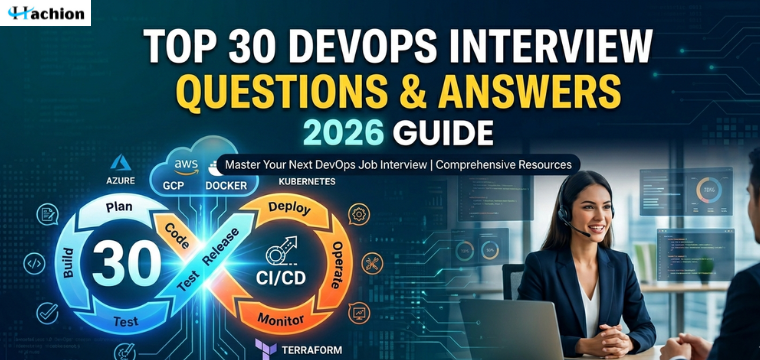
Top 30 DevOps Interview Questions & Answers 2025
DevOps has become one of the most sought-after career paths in 2025. Companies are looking for professionals who can bridge development and operations, streamline software delivery, and improve system reliability. If you’re preparing for a DevOps interview, having a strong understanding of core concepts, tools, and best practices is essential. This guide covers 30 commonly asked DevOps interview questions with answers, explanations, examples, and tips to help you ace your next interview.
1. What is DevOps?
Answer:
DevOps is a combination of development (Dev) and operations (Ops) practices that emphasizes collaboration, automation, and continuous improvement to deliver software faster and more reliably.
Explanation:
It’s not just a set of tools but a culture and mindset aimed at breaking silos between teams.
Tip:
Focus on the cultural aspect during interviews, not just tools.
2. What are the key benefits of DevOps?
Answer:
- Faster delivery of features
- Improved collaboration between teams
- Reduced deployment failures
- Faster recovery from failures
- Increased efficiency through automation
Example:
A company using CI/CD pipelines can release updates daily instead of monthly.
3. What is CI/CD?
Answer:
Continuous Integration (CI) involves integrating code changes frequently into a shared repository. CD (Continuous Delivery/Deployment) automates releasing code to production.
Tip:
Highlight your experience with Jenkins, GitLab CI/CD, or GitHub Actions if asked.
4. What is Infrastructure as Code (IaC)?
Answer:
IaC allows you to manage infrastructure using code instead of manual processes.
Tools: Terraform, Ansible, CloudFormation
Example:
Deploying servers in AWS with Terraform scripts ensures consistency and repeatability.
5. Explain the difference between Continuous Delivery and Continuous Deployment
Answer:
Continuous Delivery: Code changes are automatically prepared for production, but deployment requires approval.
Continuous Deployment: Code changes automatically go to production after passing tests.
6. What is a Version Control System (VCS)?
Answer:
A VCS tracks changes in code over time. Git is the most popular VCS.
Example:
Using Git, developers can collaborate and roll back changes if something breaks.
7. What is Git, and why is it used?
Answer:
Git is a distributed version control system that tracks changes in code and enables collaboration.
Tip:
Mention Git commands like clone, commit, and merge during interviews.
8. What is a build tool?
Answer:
A build tool automates tasks like compiling code, running tests, and packaging applications.
Example Tools: Maven, Gradle, Ant
9. Explain the difference between Agile and DevOps
Answer:
Agile focuses on development processes and delivering small features frequently.
DevOps focuses on end-to-end delivery, including development, deployment, monitoring, and operations.
10. What are the stages of the DevOps lifecycle?
Answer:
https://api.hachion.co/prod/upload_all_images/Cloud_Courses_DevOps_Devops.png
- Plan
- Code
- Build
- Test
- Release
- Deploy
- Operate
- Monitor
Tip:
Be ready to explain the tools used at each stage.
11. What is containerization?
Answer:
Containerization packages an application and its dependencies into a lightweight, portable container.
Example: Docker is widely used for this purpose.
12. What is Docker?
Answer: “With Docker, you can build, distribute, and run applications in isolated, lightweight containers that work seamlessly anywhere.”
Tip:
You can mention Docker images, Docker Hub, and Docker Compose for multi-container apps.
13. What is Kubernetes?
Answer:
Kubernetes is a container orchestration tool that automates the deployment, scaling, and management of containerized applications.
Example:
K8s automatically restarts failed containers and balances loads across servers.
14. What is a microservices architecture?
Answer:
It’s an architectural style where applications are built as small, independent services that communicate via APIs.
Tip:
Highlight how microservices improve scalability and fault isolation.
15. What is a CI/CD pipeline?
Answer:
“A CI/CD pipeline streamlines the workflow of merging code, running tests, and deploying applications automatically.”
Example Tools: Jenkins, GitLab CI, CircleCI
16. What is configuration management?
Answer:
It’s the practice of managing and maintaining software configuration consistently across environments.
Tools: Ansible, Puppet, Chef
17. Explain Blue-Green Deployment
Answer:
Blue-Green deployment maintains two production environments to reduce downtime and risk during releases.
Example:
Blue is live, and Green is in staging mode. After testing, traffic is switched to Green.
18. Explain Canary Deployment
Answer:
Gradually rolling out a new version to a small subset of users before full deployment to catch issues early.
19. What is monitoring in DevOps?
Answer:
Monitoring involves tracking application and infrastructure performance to identify and resolve issues.
Tools: Prometheus, Grafana, Nagios
20. What is log management?
Answer:
Collecting, analyzing, and storing logs to debug and optimize systems.
Tools: ELK Stack (Elasticsearch, Logstash, Kibana)
21. What are some common DevOps metrics?
Answer:
- Deployment frequency
- Mean time to recovery (MTTR)
- Change failure rate
- Lead time for changes
22. What is a repository in Git?
Answer:
A repository is a storage location for your project files, including code history.
23. What is branching in Git?
Answer:
Branching allows you to work on new features without affecting the main codebase.
Tip:
Highlight GitFlow or feature-branch strategies.
24. What is rollback?
Answer:
Rollback is reverting a deployment to a previous stable version in case of failure.
25. What are some common CI/CD tools?
Answer:
Jenkins, GitLab CI, CircleCI, Travis CI, Bamboo
Note: For more information regarding the DevOps tool, Click Here.
26. What is automated testing?
Answer:
Running predefined tests automatically to ensure code works as intended.
Tools: Selenium, JUnit, PyTest
27. What is artifact management?
Answer:
Managing compiled code or binaries used for deployment.
Tools: Nexus, Artifactory
28. What is serverless architecture?
Answer:
A way to run applications without managing servers, automatically scaling, and billing based on usage.
Example: AWS Lambda, Azure Functions
29. What are DevOps best practices?
Answer:
- Automate repetitive tasks
- Use CI/CD pipelines
- Monitor and log everything
- Foster collaboration between Dev and Ops teams
- Continuously improve processes
30. What tips would you give for cracking a DevOps interview?
Answer & Tips:
- Know your tools (Docker, Kubernetes, Jenkins, Terraform, Git) inside out
- Prepare real-world project examples
- Focus on problem-solving and process optimization
- Be ready to explain concepts clearly and concisely
Stay updated on cloud technologies (AWS, Azure, GCP)
Pro Tip: Hands-on experience is always better than just theoretical knowledge. Setting up small personal projects will help you answer scenario-based questions confidently.
Final Words: Level Up Your DevOps Career with Hachion
If you want to master DevOps and stand out in interviews, Hachion can guide you every step of the way. Our hands-on courses cover:
CI/CD, Docker, Kubernetes, Terraform, and more
Real-world projects and portfolio building
Expert mentorship and interview preparation
With Hachion, you’ll not only learn the tools but also gain the confidence to ace your DevOps interviews and launch a high-demand tech career.
👉 Enroll today and start your DevOps journey with Hachion!


