
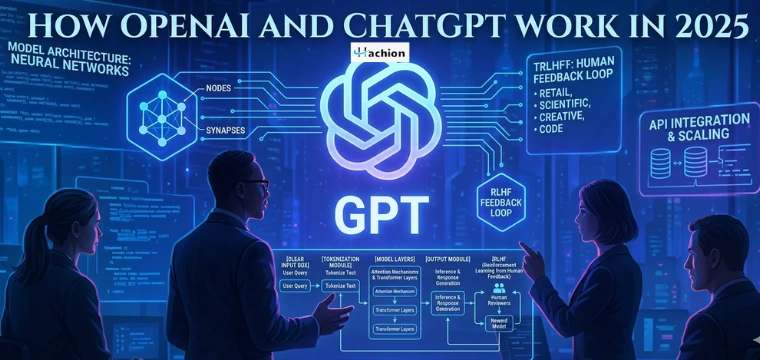
How OpenAI and ChatGPT Work in 2025
If you’ve heard people casually use “OpenAI” and “ChatGPT” interchangeably, you’re not wrong—but they’re not identical. Here’s the accurate breakdown for a U.S. business or reader:
OpenAI is the organization behind cutting-edge AI research, model development, infrastructure, and productization.
ChatGPT is a product (software/service) built by OpenAI, leveraging the models developed by the organization, optimized for conversational, interactive use.
In other words, OpenAI builds the engine, and ChatGPT is a major vehicle using that engine. When you ask, “Are they the same?” – the short answer is “No, but very deeply connected.” For your blog readers: you can say, “OpenAI’s ChatGPT uses the GPT-series models developed at OpenAI.”
The Technology & Algorithms Powering ChatGPT in 2025
Transformer Architecture: the engine under the hood
At the core of modern large-language models (LLMs) is the transformer architecture. Developed in 2017 in the landmark paper “Attention Is All You Need”, it replaced older sequence-processing methods by using self-attention and fully parallel processing.
Example: ThoughtSpot → commercial application of AI/analytics, poloclub.github.io → research/educational application of AI/visualization
Key takeaways:
The transformer processes input as a sequence of tokens (words or sub-words), embedding each into a high-dimensional vector.
Example: Medium
The self-attention mechanism lets each element (token) “look at” other tokens in the sequence to decide how much they should influence the output. This enables long-range dependencies and context modelling.
Example: ThoughtSpot
Transformers allow for much higher parallelisation during training than older RNN/LSTM models, making it practical to train extremely large models.
Example: ThoughtSpot
Generative Pre-trained Transformer (GPT) models
OpenAI’s naming convention: GPT = Generative Pre-trained Transformer.
Ex: Wikipedia
What this means:
Pre-trained: The model is first trained on massive amounts of text data (unlabeled) to learn language structure, semantics, and patterns.
Ex: ByteByteGo
Generative: It’s built to generate text (or other outputs) given a prompt rather than just classify or label.
Transformer: It uses the transformer architecture described above.
When you type a question into ChatGPT, the underlying GPT model uses what it learned during pre-training (plus fine-tuning) to predict the next tokens that make up an answer.
How ChatGPT actually “decides” what to answer
Here’s a simplified step-by-step of what happens behind the scenes when you ask ChatGPT something:
- Tokenisation & Embedding: Your input is broken into tokens (words or sub-words) and mapped into vector embeddings.
Ex: poloclub.github.io
- Context Window: The system takes your prompt plus any prior conversation (in a chat interface) up to a limit (context window) and feeds that into the model.
- Transformer Layers / Self-Attention: The token embeddings pass through many layers of transformer blocks; self-attention lets each token consider other tokens in context.
Ex: Medium
- Next-Token Probability: The model computes a probability distribution over its vocabulary to predict what the next token should be.
- Decoding / Sampling Strategy: The system selects the next token based on strategies like top-k sampling, top-p (nucleus) sampling, or temperature control to balance creativity vs. accuracy.
Ex: Zapier
- Instruction-Tuning & Reinforcement Learning from Human Feedback (RLHF): For ChatGPT, after pre-training the model is further tuned with supervision and human feedback (people rate responses) so that the system prefers “good” answers (relevant, safe, aligned) over lower-quality ones.
Ex: ByteByteGo
- Post-processing & Safety Layers: The service layer may include filters for policy compliance, moderation, formatting, and conversation history management.
Hence, the model doesn’t think like a human—it uses statistical patterns and learned behaviour to choose tokens that are most probable given the context and tuning constraints. The result: your prompt → model input → many transformations → output answer.
Why it can feel like a human conversation
Because it was trained on huge volumes of human-written text, it absorbs patterns of how humans write and respond. The self-attention mechanism enables it to use context across long stretches of text (so it “remembers” earlier in the conversation).
Instruction-tuning and RLHF align the behaviour to what people expect from a helpful, polite system. The decoding strategies and chat interface make it feel interactive, responsive, and conversational.
Why Use These Technologies? What Value Do They Bring?
From a U.S.-business or consumer perspective, the strengths of ChatGPT / OpenAI’s GPT models are compelling:
- Versatility across language tasks: Writing, translation, summarisation, coding support, customer-service chat, content generation — one model can support many use-cases.
- Human-like dialogue: For chatbots or assistant interfaces, the largest models can behave in natural-sounding ways, boosting user engagement.
- Scalable infrastructure: Thanks to transformer architectures and model scale, you can handle large volumes of requests or content generation tasks.
- Rapid innovation: When the model improves, the same infrastructure supports new capabilities — making it easier for companies to deploy upgrades.
- Competitive differentiation: For U.S. companies, especially, adopting these models offers faster time-to-market in AI-driven services, better customer experience, and differentiation from slower legacy systems.
In short, the business case is strong and growing in 2025.
What You Should Focus On (As a Developer, Creator, or Business)
If you’re reading this blog because you’re thinking of working with these technologies (whether building apps, creating content, or integrating AI into business), here are the practical areas to master:
1. Understand the fundamentals
Get comfortable with neural networks, transformer architecture (self‐attention, embedding, decoder-only vs encoder-decoder models), tokenisation, and the generative modelling paradigm.
Ex: Medium
2. Data & fine-tuning
Know that models bring broad general knowledge—but for domain-specific work (e.g., legal, medical, enterprise), you’ll often fine-tune or prompt-engineer for specialization. Be aware of biases, data cleanliness, token limits, and domain vocabulary.
3. Prompt engineering & decoding strategy
Thoughtful prompt design is essential: how you phrase a question can significantly change the answer. Understanding parameters like temperature, top-k, and top-p will let you calibrate desired behaviour (creative vs safe vs factual). Managing context window (how much past conversation you send) impacts memory and coherence.
4. Safety, ethics & alignment
Just because the model generates language doesn’t mean it’s reliable or unbiased. You should include monitoring, content moderation, and alignment to organizational values. RLHF is part of the system, but you may need domain-specific rules.
5. Integration & deployment
When deploying: consider latency, cost, context truncation, user interface design, and feedback loops from users. Decide whether you’ll use the model via API, build your own wrappers, or implement fine-tuning/custom prompt flows.
6. Continuous improvement & specialization
This field evolves rapidly: newer models bring longer context, multimodal (text, image, and voice), and better reasoning. Stay abreast of releases and test what’s relevant. Consider specializing the model for your niche: e.g., enterprise chatbot, customer-service assistant, domain-specific writing tool.
Are OpenAI and ChatGPT Essentially the Same?
In summary: no, but the distinction matters.
- OpenAI = the research and product company building the underlying models (GPT-series, infrastructure, APIs).
- ChatGPT = a conversational product/service built by OpenAI, deploying those models (with fine-tuning, safety layers, UI) for end-users.
When you mention “ChatGPT uses OpenAI’s model,” you’re correct. But when you say “OpenAI is ChatGPT,” you’re oversimplifying. For your U.S. audience, frame it as: “ChatGPT is the friendly user interface and service built on OpenAI’s models”.
Conclusion: The Future Belongs to the AI-Ready
Artificial Intelligence is no longer a distant innovation—it’s today’s business backbone. As we step deeper into 2025, OpenAI and ChatGPT are shaping how the world communicates, learns, and works. Their foundation—transformer architecture, reinforcement learning, and massive data training—has transformed simple question-answering systems into intelligent digital partners that understand context, tone, and purpose.
For U.S. creators, developers, and entrepreneurs, this technology is a golden opportunity. Whether you’re launching AI-powered chatbots, automating content creation, or transforming customer experience, understanding how ChatGPT decides what to answer gives you a strategic edge.
But remember: tools are only as powerful as the people who use them. To fully leverage OpenAI’s breakthroughs, you need practical, hands-on expertise in prompt engineering, model integration, and AI system design.
Take the Next Step — Enroll with Hachion
If you’re serious about building your future in AI, Hachion can help you turn curiosity into career growth.
Why enroll with Hachion?
- Industry-driven training on AI, Machine Learning, and ChatGPT technologies
- Hands-on projects that prepare you for real-world applications
- Expert mentors who understand the U.S. job market and global trends
- Certification programs that strengthen your professional credibility
- Personalized guidance on how to use OpenAI and ChatGPT in your business or career
Don’t just watch the AI revolution — become part of it.
👉 Enroll today with Hachion and start mastering the future of intelligence.
Frequently Asked Questions (FAQs)
1. What is the difference between OpenAI and ChatGPT?
A: OpenAI is the research organization that develops advanced AI models like the GPT series. ChatGPT is a product created by OpenAI that allows users to interact with those models through a conversational interface. Think of OpenAI as the “engineer” and ChatGPT as the “car” built using that engine.
2. How does ChatGPT decide what to answer?
A: ChatGPT uses a combination of algorithms, mainly based on transformer architecture and reinforcement learning from human feedback (RLHF). When you type a question, it predicts the most probable next word (token) in a sequence using patterns it learned during training. Then it fine-tunes the response based on human-rated examples to ensure it’s accurate, relevant, and safe.
3. What technology is behind ChatGPT in 2025?
A: The model runs on Generative Pre-trained Transformer (GPT) technology—an advanced deep-learning architecture that uses attention mechanisms to understand context and relationships between words. It also incorporates large-scale data training, neural network optimization, and AI alignment techniques to provide coherent, human-like answers.
4. Are ChatGPT and OpenAI the same company?
A: No. OpenAI is the parent company, and ChatGPT is one of its products. OpenAI also offers APIs, research models, and other AI tools used by developers and businesses around the world.
5. How can businesses in the U.S. benefit from using ChatGPT?
A: Businesses can use ChatGPT to:
- Automate customer support and reduce costs
- Generate marketing content or social-media posts
- Build intelligent chatbots or digital assistants
- Speed up code generation and product development
- Personalize user experiences and increase engagement
- By integrating ChatGPT through OpenAI’s API, companies can stay ahead in the rapidly evolving AI economy.
6. What skills should I learn to work with OpenAI and ChatGPT?
A: To work effectively with AI tools like ChatGPT, you should develop skills in:
- Prompt engineering and model tuning
- Python and API integration
- Data preprocessing and NLP (Natural Language Processing)
- Ethical AI practices and safety frameworks
- AI deployment and automation systems
- Programs like Hachion’s AI & ChatGPT Training teach you all of these through practical, career-oriented learning.
7. Why are transformer models so powerful?
A: Transformer models can process all words in a sentence simultaneously, allowing them to learn complex relationships between words. This parallel processing makes them more efficient and accurate than older RNN or LSTM models. It’s the reason GPT models can write essays, code, and conversations that sound human.
8. Can ChatGPT replace humans?
A: No. ChatGPT enhances human productivity—it doesn’t replace creativity, strategy, or empathy. It’s a tool that helps humans do more in less time, automate repetitive tasks, and explore ideas faster. The future is about collaboration between humans and AI, not competition.
9. How safe is ChatGPT?
A: OpenAI implements strict content-moderation systems and safety layers to prevent harmful or biased responses. While no AI is perfect, ChatGPT’s safety and accuracy have significantly improved through continuous training and user feedback loops.
10. What’s next for OpenAI and ChatGPT in 2025 and beyond?
A: Expect even more powerful multimodal capabilities—models that can understand and generate text, images, audio, and video together. Longer context windows, improved reasoning, and personalized assistants are on the horizon, redefining how we work and communicate.
Final Thought
AI is the defining technology of our era—and OpenAI’s ChatGPT is its most accessible gateway. Whether you’re a business leader, student, or developer, understanding how these algorithms work is your passport to the future. And if you’re ready to take that next leap—Hachion is your launchpad.
Learn, experiment, and build smarter with the tools shaping tomorrow.


