
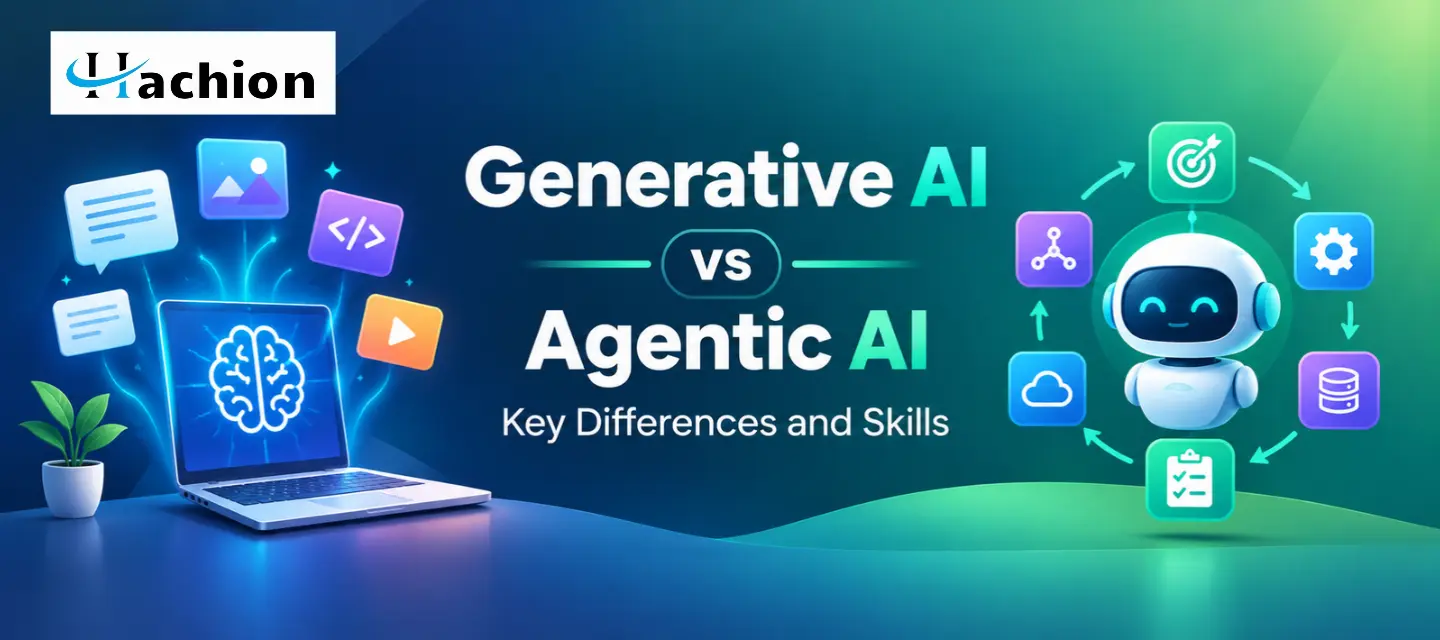
Generative AI vs Agentic AI: Key Differences and Skills
Artificial intelligence is changing how businesses create content, analyze information, and manage everyday tasks. Understanding Generative AI vs Agentic AI can help students, working professionals, and career changers identify which AI skills are worth learning.
Both technologies use AI, but each serves a different purpose. Generative AI creates content based on user instructions, while Agentic AI can work toward a goal by planning steps, using tools, and taking actions with appropriate permissions. Knowing the difference helps learners understand how AI is used in modern workplaces across the USA.
What Is Generative AI?
Generative AI can produce different types of content, such as written text, images, code, audio, and summaries, based on the instructions it receives. It learns patterns from training data and uses them to generate responses based on prompts.
For example, a marketing professional can use ChatGPT to draft an email campaign, summarize customer feedback, or generate ideas for a blog. A software developer can use AI coding tools to explain code or suggest improvements.
Common applications include:
- Content creation: Drafting blogs, emails, reports, and social media posts.
- Software development: Generating code examples and explaining programming concepts.
- Data analysis: Summarizing findings and helping interpret information.
- Customer support: Drafting responses to frequently asked questions.
Generative AI tools can save time and support creative work. However, users must review their outputs because AI-generated information can contain errors, outdated details, or unsupported claims.
What Is Agentic AI?
Agentic AI helps AI systems work toward a specific goal by planning tasks and carrying out the steps needed to achieve it. Depending on their design, these systems can use external tools, retrieve information, interact with software, and evaluate results before proceeding.
For example, imagine a sales team that needs a weekly performance report. An AI agent could retrieve authorized sales data, calculate key metrics, identify changes, prepare a summary, and send the report for approval.
Common Agentic AI applications include:
- Business process automation: Coordinating repetitive tasks across applications.
- Customer service: Retrieving information and helping resolve customer requests.
- Data operations: Collecting, processing, and summarizing information from approved sources.
- Software workflows: Running permitted checks and reporting errors for developers.
Agentic AI can do more than generate a single response, but it is not automatically reliable or fully independent. Its actions depend on the tools, permissions, instructions, and safeguards configured by its developers.
Generative AI vs Agentic AI: Key Differences
Generative AI and Agentic AI serve different purposes, even though both use artificial intelligence. Generative AI helps produce content based on instructions, while Agentic AI can organize and carry out a series of steps to reach a specific goal. Understanding how each technology works makes it easier to identify where it can be useful.
How Does Generative AI Work?
Generative AI responds to user prompts by creating content, offering suggestions, or answering questions. It is particularly useful when a task involves writing, explaining, summarizing, or generating ideas.
- Main purpose: Creates content, answers, and suggestions.
- Task handling: Usually works from the instructions provided in a prompt.
- Human involvement: Users review the output and decide how to use it.
- Tools and integration: Can operate as a standalone assistant or connect with other applications.
- Practical example: A customer support representative uses Generative AI to draft a polite email explaining a delayed order.
How Does Agentic AI Work?
Agentic AI takes a more goal-oriented approach. It can divide a task into smaller steps, use connected tools, review results, and determine what to do next within its configured permissions.
- Main purpose: Works toward completing a specific goal.
- Task handling: Coordinates multiple steps instead of focusing only on a single response.
- Human involvement: Can perform approved actions with limited supervision, while important decisions may require human approval.
- Tools and integration: Can connect with APIs, databases, and business applications to carry out tasks.
- Practical example: An AI agent checks an order's status, gathers the relevant delivery information, drafts a customer response, and sends it for approval before it is delivered.
Can These Two Technologies Work Together?
Yes. Generative AI can create the content needed during a workflow, while Agentic AI coordinates the actions required to complete the task. For example, an AI-powered customer support system can use a generative model to write a response and an AI agent to retrieve order details and route the message for review.
Combining these capabilities can help businesses streamline repetitive work while keeping people involved in decisions that require judgment.
Real-World Workflow Example: Customer Support
Consider an online retailer in the United States that receives hundreds of customer inquiries about order delays.
With Generative AI, a support representative can summarize a customer's message and draft a clear response explaining the delay.
With Agentic AI, a configured system could follow a broader workflow:
- Receive a customer inquiry through an approved support platform.
- Retrieve the order status from an authorized system.
- Check the company's delivery and refund policies.
- Use a generative AI tool to create a reply tailored to the customer's situation.
- Flag unusual cases or route refund requests for human approval.
- Record the outcome in the support system when authorized.
This workflow illustrates how both technologies can complement each other. Generative AI helps create the response, while Agentic AI coordinates the steps needed to address the request.
Businesses should also protect customer information, restrict system permissions, and monitor actions to reduce errors and unauthorized changes.
What Skills Should You Learn?
Choosing between Generative AI and Agentic AI depends on your current knowledge, career interests, and learning goals.
Skills for Generative AI
Start with these practical skills:
- Prompt engineering and clear instruction writing.
- Using generative AI tools for research, writing, and coding.
- Understanding AI limitations, hallucinations, and responsible use.
- Evaluating AI-generated content for accuracy and quality.
- Basic Python or API knowledge for more technical applications.
These skills are useful for content professionals, analysts, developers, marketers, and other professionals who want to integrate AI into their work.
Skills for Agentic AI
To build more advanced AI workflows, focus on:
- Python programming and API integration.
- Understanding large language models and tool calling.
- Workflow design and task decomposition.
- Working with databases and structured information.
- Testing, monitoring, access controls, and human approval processes.
Knowledge of frameworks for building AI agents can be useful after you understand the fundamentals. Beginners do not need to master every tool immediately; start with basic AI concepts and gradually build practical projects.
Learn AI with Hachion Online Trainings
Learning AI becomes more meaningful when you apply concepts to realistic business problems. Hachion Online Trainings can help learners explore Generative AI, Agentic AI, and related technical skills through structured learning and practical exercises.
When choosing a training program, look for opportunities to practice prompt engineering, understand how AI models work, build tool-connected workflows, and evaluate AI outputs responsibly. A useful learning project could involve creating a research assistant, developing a customer-support workflow, or automating a report with human approval.
Explore all the available AI training options to identify a learning path that matches your experience and goals. Consistent practice and a portfolio of working projects can help you demonstrate your skills to potential employers in the USA.
Final Thought
Learning about Generative AI and Agentic AI can help you choose the skills that match your career goals. Generative AI is useful for creating content and solving problems, while Agentic AI helps manage tasks through connected, step-by-step workflows. Start with AI fundamentals, practice on real-world problems, and gradually develop the technical skills needed to build useful, responsible AI solutions.
Frequently Asked Questions (FAQ’s)
1. How are Generative AI and Agentic AI Different?
A: Generative AI creates content such as text, images, and code. Agentic AI works toward a goal by planning steps, using tools, and coordinating actions within defined permissions.
2. Is Agentic AI better than Generative AI?
A: Neither is universally better. Generative AI is useful for content creation and information assistance, while Agentic AI is useful for workflows involving multiple steps. The right choice depends on the task.
3. What skills are needed to learn Agentic AI?
A: Useful skills include Python, APIs, prompt engineering, large language models, workflow design, and AI evaluation. Beginners can start with basic AI concepts before progressing to agent development.
4. How can Generative AI and Agentic AI work together?
A: An AI agent can use a generative AI model to interpret instructions, summarize retrieved information, or generate responses while coordinating a larger workflow.
5. Does Hachion Online Trainings offer Generative AI and Agentic AI training?
A: Hachion Online Trainings provides technology training options. Visit the official Hachion website to explore current AI courses, course content, learning formats, and available training schedules.


