
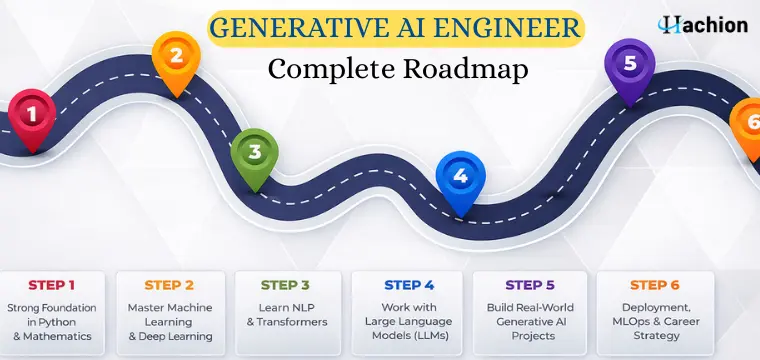
How to Become a Generative AI Engineer: Complete Career Roadmap
Generative AI has moved far beyond experimentation. In 2026, it powers enterprise copilots, AI-driven customer support, automated content systems, and intelligent analytics platforms. Innovations from organizations like OpenAI and Google DeepMind have accelerated adoption across industries, making Generative AI one of the most in-demand career paths today.
If you are planning to become a Generative AI Engineer, this roadmap will help you understand what to learn, how to practice, and how to position yourself professionally.
What Is a Generative AI Engineer?
A Generative AI Engineer builds systems capable of generating text, images, code, audio, or video using advanced AI models. These professionals work with Large Language Models (LLMs), transformer architectures, and multimodal systems to develop production-ready applications.
Unlike traditional machine learning roles, Generative AI Engineers focus on:
- Prompt engineering and optimization
- Fine-tuning foundation models
- Retrieval-Augmented Generation (RAG) systems
- AI agents and workflow automation
- Model deployment and scaling
It is a hybrid role combining deep learning expertise with strong software engineering skills.
Step 1: Build Strong Foundations (0–3 Months)
Before diving into advanced AI systems, you must master the fundamentals.
- Learn Python Programming
- Python remains the dominant language in AI development. Focus on:
- Data structures and algorithms
- APIs and REST services
- Object-oriented programming
- Writing clean, modular code
You should be comfortable building backend services before integrating AI models.
Understand Core Mathematics
You do not need advanced research-level math, but you must understand:
- Linear algebra
- Probability and statistics
- Basic calculus
- Optimization techniques
These concepts are the backbone of neural networks and transformer models.
Step 2: Master Machine Learning and Deep Learning (3–6 Months)
Generative AI is built on deep learning foundations. Without understanding neural networks, it is difficult to design effective systems.
Focus on:
- Supervised and unsupervised learning
- Neural networks and backpropagation
- CNNs and RNNs
- Transformer architecture
Work with frameworks such as PyTorch and TensorFlow. Learn how transformers revolutionized NLP and enabled modern LLMs.
Step 3: Understand Large Language Models (6–9 Months)
This is where you transition into Generative AI specialization.
Key concepts to learn:
- Self-attention mechanism
- Tokenization and embeddings
- Fine-tuning vs prompt engineering
- LoRA and parameter-efficient tuning
- Reinforcement Learning from Human Feedback (RLHF)
- Study open-source advancements, such as models from Meta AI, and how they changed accessibility in AI development.
Understanding model evaluation and alignment techniques will give you a competitive advantage.
Step 4: Learn Prompt Engineering and RAG Systems
In 2026, prompt engineering alone is not enough. Companies require AI systems connected to live data.
- Master Prompt Engineering
- Zero-shot and few-shot prompting
- Chain-of-thought reasoning
- Structured output design
- System prompt optimization
- Build Retrieval-Augmented Generation (RAG) Systems
RAG combines LLMs with external knowledge sources using vector databases and embeddings.
Focus on:
- Semantic search
- Chunking strategies
- Embedding models
- Vector databases
Tools like LangChain and LlamaIndex are widely used in production systems. RAG development is one of the most employable skills in today’s AI job market.
Step 5: Work With Multimodal AI
- Generative AI now extends beyond text.
- Text-to-image diffusion models
- Speech-to-text systems
- Video generation pipelines
Organizations such as Stability AI have accelerated open-source multimodal development. Learning multimodal AI will differentiate you from other candidates.
Step 6: Learn AI Deployment and System Design
Companies hire engineers who can deploy, not just experiment.
You must understand:
- FastAPI or Flask for model serving
- Docker and containerization
- Kubernetes basics
- Cloud platforms like AWS or Azure
- Monitoring, logging, and scaling
Production readiness is what separates hobbyists from professionals.
Step 7: Build Real-World Projects
Certifications help, but portfolios get interviews.
Build projects such as:
- AI customer support chatbot with RAG
- Resume screening assistant
- Code generation tool
- AI knowledge-base agent
Deploy your projects, write documentation, and showcase them on GitHub and LinkedIn. Demonstrating real implementation experience significantly increases job opportunities.
Step 8: Understand AI Ethics and Governance
Responsible AI is a business priority in 2026.
Learn about:
- Bias mitigation
- Data privacy regulations
- Model transparency
- Safety alignment
Institutions like Stanford University and MIT actively research AI governance frameworks. Awareness of ethical AI practices strengthens your long-term career prospects.
Career Specializations in Generative AI
You can specialize in different tracks:
- LLM Engineer - Focus on fine-tuning and model optimization.
- AI Agent Engineer - Build autonomous task-executing systems.
- AI Infrastructure Engineer - Optimize deployment and scalability.
- Applied Generative AI Engineer - Solve business-specific problems.
Choosing a niche helps you build deeper expertise.
FAQs
1. Do I need a degree to become a Generative AI Engineer?
A: No. A degree helps, but strong practical skills, projects, and a portfolio matter more than formal education.
2. How long does it take to become job-ready?
A: Beginners typically need 9 to 12 months of consistent learning. Developers with prior experience may transition within 4 to 6 months.
3. Is coding mandatory for Generative AI?
A: Yes. While no-code tools exist, serious roles require Python, APIs, and deployment knowledge.
4. What salary can I expect in 2026?
A: Salaries vary by region, but Generative AI Engineers are among the highest-paid tech professionals due to high demand and limited expertise.
5. Is prompt engineering alone enough to get a job?
A: No. Employers expect knowledge of RAG systems, fine-tuning, deployment, and production-level architecture.
Accelerate Your Career with Structured Learning
Self-learning works, but structured training accelerates growth. If you want guided mentorship, real-world projects, and industry-focused curriculum, consider enrolling in the Generative AI Online Training Course offered by Hachion.
Hachion’s program focuses on:
- Hands-on LLM projects
- RAG system development
- AI agent workflows
- Deployment and cloud integration
- Interview preparation and portfolio building
A structured course can help you avoid confusion and focus on industry-relevant skills.
Final Thoughts
Becoming a Generative AI Engineer in 2026 is not about chasing trends; it is about building practical, deployable systems that solve real problems. Master the fundamentals, specialize in LLMs and RAG systems, build real projects, and focus on production deployment.
The opportunity is massive. The demand is growing. The path is clear.
If you start today and remain consistent, you can position yourself as a highly valuable Generative AI Engineer within a year.
The future belongs to builders. Are you ready to build?


