
Why Agentic AI Is the Next Big Thing in Artificial Intelligence
Artificial intelligence is evolving rapidly, and one of the most discussed topics today is Agentic AI vs LLM. Businesses, developers, students, and technology professionals are trying to understand how these technologies differ and what they mean for the future of innovation.
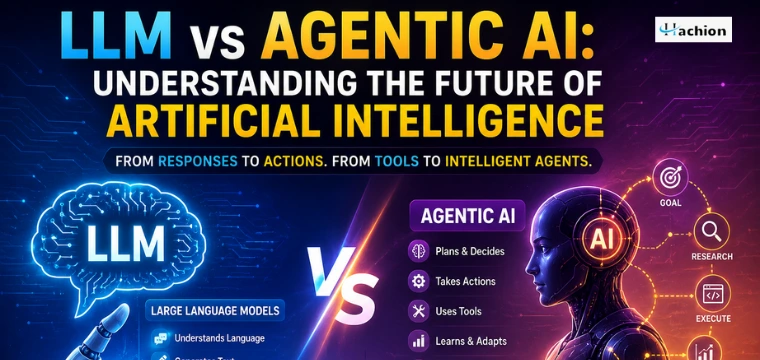
The discussion around Agentic AI vs LLM is important because both technologies are transforming industries in different ways. While Large Language Models (LLMs) excel at generating human-like content and answering questions, Agentic AI goes a step further by making decisions, planning actions, and completing tasks with minimal human intervention. Understanding these differences can help learners and professionals prepare for the next wave of AI-driven opportunities.
What Are Large Language Models (LLMs)?
Large Language Models are advanced artificial intelligence systems trained on massive amounts of text data. They are designed to understand, generate, summarize, and translate human language.
Popular examples of LLMs include ChatGPT, Claude, and Gemini, as well as other conversational AI systems.
Key capabilities of LLMs include:
- Content creation
- Code generation
- Language translation
- Text summarization
- Customer support automation
- Knowledge retrieval
LLMs are highly effective at processing and generating language. However, they generally require user prompts to perform tasks and do not independently plan or execute complex workflows.
What Is Agentic AI?
Agentic AI refers to intelligent systems that can make decisions, create plans, take actions, and adapt to changing situations while working toward a specific goal.
Unlike traditional AI systems that only respond to instructions, Agentic AI can operate with greater autonomy.
For example, if an LLM is asked to write an email, it will generate the email. An AI agent, on the other hand, could:
- Gather information
- Analyze data
- Draft the email
- Send it to recipients
- Monitor responses
- Schedule follow-up actions
All of these tasks can be performed as part of a coordinated workflow.
Agentic AI vs LLM: Key Differences
Understanding Agentic AI vs LLM becomes easier when comparing their core characteristics.
Purpose
- LLMs focus on generating content and responding to prompts.
- Agentic AI focuses on achieving goals by planning and executing actions.
Decision-Making
- LLMs provide responses based on learned patterns.
- Agentic AI evaluates situations and makes decisions based on objectives.
Autonomy
- LLMs require continuous user instructions.
- Agentic AI can work independently with minimal supervision.
Task Execution
- LLMs generate outputs such as text, code, or summaries.
- Agentic AI can interact with tools, software systems, APIs, and databases to complete tasks.
Adaptability
- LLMs respond to prompts.
- Agentic AI adapts strategies based on changing conditions and outcomes.
Why Agentic AI Is Gaining Attention
Organizations are increasingly seeking AI systems that can do more than answer questions. Businesses want solutions that can automate entire processes and improve operational efficiency.
Agentic AI is gaining popularity because it offers:
- Improved productivity
- Faster decision-making
- Workflow automation
- Reduced manual effort
- Enhanced customer experiences
- Better business scalability
From healthcare and finance to software development and cybersecurity, AI agents are being explored as powerful tools for managing complex operations.
Real-World Applications of Agentic AI
Agentic AI is already showing potential across multiple industries.
Customer Support
AI agents can resolve customer issues, access knowledge bases, escalate tickets, and provide personalized assistance.
Software Development
AI agents can write code, perform testing, identify bugs, and deploy applications with limited human involvement.
Healthcare
Healthcare organizations can use AI agents for appointment scheduling, patient monitoring, and medical documentation.
Cybersecurity
Security teams can use AI agents to detect threats, analyze vulnerabilities, and automate incident response.
Finance
Financial institutions can leverage AI agents for fraud detection, risk analysis, portfolio management, and customer support.
Will Agentic AI Replace LLMs?
The simple answer is no.
Agentic AI and LLMs are complementary technologies rather than competitors.
In many cases, Agentic AI systems use LLMs as their reasoning and communication engines. The LLM provides language understanding and content generation capabilities, while the AI agent handles planning, decision-making, and execution.
Future AI systems will likely combine both technologies to create more intelligent and autonomous solutions.
Career Opportunities in Agentic AI
The growing adoption of AI agents is creating exciting career opportunities for students and professionals.
Some emerging roles include:
- AI Engineer
- Machine Learning Engineer
- AI Agent Developer
- Prompt Engineer
- AI Solutions Architect
- Automation Engineer
- Data Scientist
- Generative AI Specialist
As organizations invest more in intelligent automation, professionals with expertise in AI agents and large language models will be in high demand.
How to Learn Agentic AI
Students and working professionals interested in building a future-ready career should focus on developing skills in:
- Python Programming
- Machine Learning
- Generative AI
- Large Language Models
- Prompt Engineering
- AI Agent Development
- Cloud Computing
- API Integration
- Automation Tools
Hachion offers industry-focused online training programs designed to help learners build practical skills in Artificial Intelligence, Machine Learning, Generative AI, Cloud Computing, DevOps, Data Science, and Cybersecurity. Through live instructor-led sessions, hands-on projects, and real-world assignments, learners can gain the knowledge required to succeed in modern technology careers and stay competitive in an AI-driven job market.
The Future of Artificial Intelligence
The future of artificial intelligence is moving beyond simple chatbots and content generators. Organizations are increasingly looking for intelligent systems that can reason, plan, and execute tasks independently.
While Large Language Models have transformed how humans interact with technology, Agentic AI represents the next step in AI evolution. Together, these technologies will power smarter business processes, improve productivity, and create new opportunities across industries.
For students, professionals, and technology enthusiasts, understanding Agentic AI vs LLM is becoming essential for staying ahead in the rapidly changing world of artificial intelligence.
Frequently Asked Questions (FAQs)
1. Difference between Agentic AI and LLM?
A: LLMs generate text and respond to prompts, while Agentic AI can plan, make decisions, and execute tasks autonomously to achieve specific goals.
2. Can Agentic AI work without LLMs?
A: Some Agentic AI systems can use alternative AI models, but many modern AI agents rely on LLMs for reasoning, communication, and content generation.
3. Is Agentic AI the future of artificial intelligence?
A: Many experts believe Agentic AI will play a major role in the future because it enables autonomous task execution and advanced workflow automation.
4. Which industries benefit most from Agentic AI?
A: Healthcare, finance, cybersecurity, software development, customer support, and logistics are among the industries expected to benefit significantly.
5. What skills are needed to become an AI Agent Developer?
A: Python, machine learning, generative AI, prompt engineering, cloud computing, API integration, and automation frameworks are important skills.
6. Should students learn LLMs before Agentic AI?
A: Yes. Understanding Large Language Models provides a strong foundation before learning how AI agents use those models to perform complex tasks.
7. Are AI agents replacing human jobs?
A: AI agents are automating repetitive tasks, but they are also creating new career opportunities in AI development, management, and deployment.
8. How can I start a career in Artificial Intelligence?
A: You can begin by learning programming, machine learning, generative AI, and AI agent development through structured training programs, practical projects, and certifications.


